
Explain How the Components of Skill-Related Fitness Are Interrelated and How Each Is of Importance
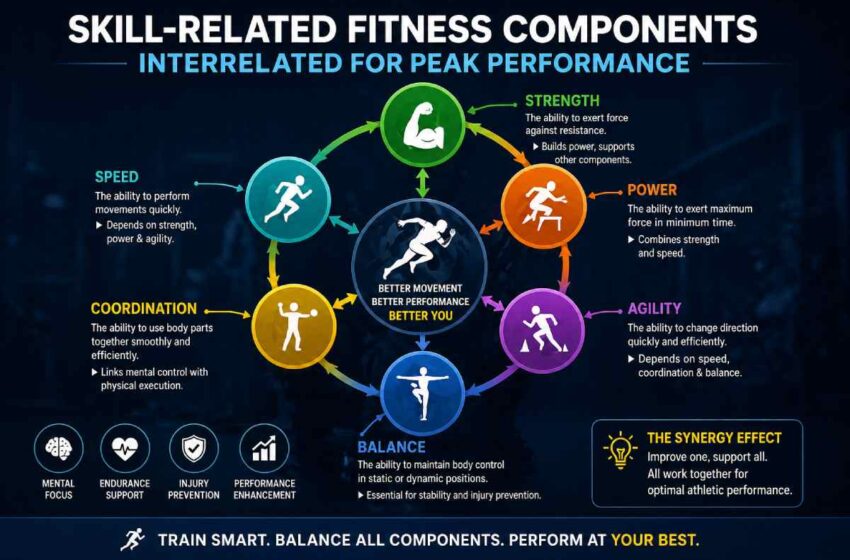
Nobody teaches you this in gym class.
You’re watching a running back dodge three defenders in under two seconds — cutting left, planting hard, accelerating right, never losing his footing. Your brain registers it as “athletic.” Coaches call it “talent.” But what’s actually happening is six distinct physical abilities firing in perfect sequence, so fast it looks effortless.
That’s skill-related fitness. And most people — even active, fit people — have never been told how it actually works.
This guide breaks down all six components, explains why none of them work alone, and shows you why training them together is what separates people who move well from people who just exercise a lot.
Table of Contents
Quick Answer (TL;DR)
- The six elements that are categorised as part of skills related fitness are: agility, balance, co-ordination, power, reaction time and speed.
- They don‘t work in complete isolation- every actual gesture draws from multiple modules.
- Train one and you“ll almost always encourage the others to move along as well.
- Irriversible is relevant for all: athletes, pros longing to age better and even ordinary people worried of falls, coaches, PE students.
- Intentional drills ladder work, plyos, balance boards for you to then construct each element consciously, one by one.
The Six Components, Defined Simply
Before getting into the connections, here’s what we’re actually talking about:
- Agility – changing direction smoothly and quickly without loss of speed or control
- Balance – how to keep steady as you walk or
- Co-ordination you can set your eyes, limbs and timing up to move as a
- Power — putting force and speed together in an explosive burst
- Reaction time — the gap between seeing something happen and your body responding to it
- Speed — how fast you can move a limb or your whole body
The American College of Sports Medicine recognizes these six as the foundation of motor performance across all age groups — not just for competitive sport, but for functional daily living too.
How the Components of Skill-Related Fitness Are Interrelated
This is where it gets interesting. A lot of textbooks list these six qualities and then stop — as if they’re separate boxes on a checklist. They’re not. They‘re not. You‘re just muddling them together, and if you train them like they are isolated you‘re going to miss out on serious performance.
Agility borrows from three other components
Think about what agility actually requires. You need to see a gap or a threat (reaction time). You need to redirect your body without stumbling (balance). And you need your feet, hips, and arms working in sync when you cut (coordination). Take any one of those away and your “agility” falls apart.
A wide receiver who can run a 4.4-second forty but has poor balance and coordination won’t consistently beat press coverage. Raw speed isn’t enough — agility is what speed looks like under pressure and with decisions involved.
Power is what coordination looks like with force behind it
Many believe the power is only to do with strength and speed. Yet two athletes can have equal leg strength but vastly different vertical leaps and this comes down to coordination; the timing and movement sequence of hip extension, knee extension and ankle plantar flexion occurring at precise angles and time..
Research in the Journal of Strength and Conditioning Research has shown time and again that neuromuscular coordination training enhances power output irrespective of muscle gain.Your body gets better at channeling the force it already has.
Reaction time quietly runs the whole show
People underestimate this one. Reaction time isn’t just a lab test where you press a button when a light flashes. In actual movement, it’s the speed at which your nervous system perceives something — a ball dropping, a defender lunging, your foot hitting an uneven patch of ground — and fires the right motor response.
Faster reaction time means you initiate speed sooner. It means you catch a stumble before it becomes a fall. It feeds directly into agility because direction changes don’t just happen — they’re triggered. Reaction time is what pulls the trigger.
Balance and speed are always negotiating with each other
There’s a fundamental tension between moving fast and staying stable. The faster you move, the more forces your body has to manage. Sprinters who are incredibly fast but have underdeveloped balance tend to break down mechanically — their technique deteriorates under fatigue or when they have to decelerate suddenly.
This explains why coaches often perform drills on somewhat sloppy terrain or employ instability equipment even for the top speed-oriented athletes.. It forces the balance system to keep pace with the speed system. The goal is what sports scientists call dynamic stability — the ability to stay controlled even when you’re moving hard.
Coordination is the thread connecting everything
If you had to pick the one component that most directly affects all the others, it’s coordination. It’s the quality that determines how cleanly your nervous system translates intention into movement. Good coordination means less wasted motion, better timing, more efficient force application.
Poor coordination is why two people can do the same agility drill and look completely different doing it. One looks smooth and controlled. The other looks jerky and rushed. Same drill. Same effort. The difference is how well their nervous systems have learned to sequence the movement.
The good news is that coordination responds strongly to deliberate practice — more so than most people realize. Juggling, ladder patterns, sport-specific skill work — these aren’t just fun. They’re literally rewiring how your brain controls your body.
Here’s a real-world example that puts it all together: a shortstop fielding a ground ball. Ball hits the ground (reaction time fires). They burst toward it (speed and power). They adjust their path mid-approach (agility and balance). They field it cleanly with one hand (coordination). They plant and throw across their body (power and balance again). That’s a two-second play. All six components.
How Each Component Connects to the Others
| Component | Relies On | Directly Strengthens |
| Agility | Balance, Coordination, Reaction Time | Overall athletic responsiveness |
| Balance | Coordination, Proprioception | Agility, safe speed expression, Power |
| Coordination | Neuromuscular control, repetition | All five other components |
| Power | Strength + Coordination + Speed | Agility, Speed |
| Reaction Time | CNS sharpness, attention | Agility, Balance, Speed |
| Speed | Power, Coordination (technique) | Agility |
Why Each Component Matters — And Not Just for Athletes
Agility
In sport, agility is what separates players who are “fast” from players who are actually hard to guard or tackle. In everyday life, it’s what lets you step around a kid who runs into your path, or avoid a wet patch on the floor.
The National Strength and Conditioning Association listed research in support of agility and neuromuscular control programs that identified large reductions in lower-extremity injuries for team-sport athletes. That’s not a trivial benefit — it’s fewer ACL tears, fewer ankle sprains.
Balance
According to the CDC, Falls are the leading cause of injury-related death in adults over 65 in the U. S. That alone should make balance training a true public health issue, not something that concerns only athletes.
For younger, active people, better balance means more efficient movement — less energy wasted stabilizing the body, more energy available for actual performance. A runner with excellent dynamic balance wastes almost no lateral movement with each stride. That efficiency adds up over miles.
Coordination
Coordination – the what sets skilled movement apart from effortless. A good coordinated athlete moves efficiently, reproducing the exact same joint angles, timing scheme and force until their nervous system cements those patterns during practice. This is of critical importance in highly technical sports like swimming, gymnastics and baseball where every tiny inch or time step counts.
But also in everyday life we‘d hardly find a useful task to name that isn‘t dependent on our coordination ability: catching an item we just dropped.
Power
Power is the most visible of the six. A dunk. A 300-pound clean and jerk. A baseball launched 450 feet. These are expressions of power, and they’re attention-grabbing for good reason.
But here’s something worth knowing: power sits at the intersection of skill-related fitness and health-related fitness. It requires muscular strength (health-related) AND speed and coordination (skill-related). Athletes who train power without addressing the skill-related side of the equation often plateau because they’re strong but imprecise — they can generate force, they just can’t direct it efficiently.
Reaction Time
One of the most common misconceptions about reaction time is that it’s genetic and fixed. It isn’t. Yes, there’s a baseline influenced by genetics and age, but reaction time improves with sport-specific practice, cognitive training, and even certain types of video game play (this is well-documented in motor learning literature).
In practical terms: a baseball hitter’s reaction time to a 95 mph fastball is almost entirely trained, not innate. A goalkeeper’s ability to dive to the right corner on a penalty kick involves reading cues and responding — a trained skill, not just reflexes.
Speed
Speed in the skill-related context isn’t limited to how fast you run. Hand speed matters in boxing and tennis. Foot speed matters in soccer dribbling. Stroke turnover speed matters in swimming. Speed of movement through a task is context-specific.
What’s also true is that raw speed without the other components is somewhat limited. A sprinter who’s extremely fast but has poor coordination has mechanical inefficiency that will eventually cap their times. Speed training works best when it’s paired with technique work — which is coordination.
Who This Actually Applies To
The components of skill-related fitness aren’t just a topic for sports science class. Here’s who genuinely benefits from understanding and developing them:
- Competitive athletes — skill-related fitness is essentially the blueprint for athletic development at any level.
- Coaches, physical educators especially important to SHAPE America curriculum standards used in all schools across the U. S.
- Older adults (55+) training on aspects such as balance, coordination and reaction time and can have the most profound quality-of-life impacts.
- Recreational fitness people who’ve hit a plateau — you might be strong and have good cardio but still move poorly. Skill-related work often unlocks progress.
- Rehab patients returning to activity — rebuilding coordination and balance is a core part of physical therapy after orthopedic injuries.
A word of caution though — if you’re early in your fitness journey, jumping straight into high-intensity agility drills or plyometrics before you have a decent base of strength and movement quality is a recipe for injury. Build the foundation first.
Training All Six Together: A Practical Framework
The biggest mistake people make is treating these components as separate training sessions. Monday is speed day. Wednesday is balance day. It doesn’t work that way in real life, and training shouldn’t be siloed either.
Here’s a general progression that sports coaches use — adapted here for clarity:
| Phase | Primary Focus | Example Drills |
| Weeks 1–3 (Foundation) | Balance + Coordination | Single-leg stands, agility ladder patterns, juggling progressions, slow-tempo footwork |
| Weeks 4–6 (Build) | Speed + Reaction Time | Short acceleration sprints, partner reaction drills, medicine ball catches |
| Weeks 7–9 (Integration) | Agility + Power | Reactive cone drills, box jumps, sprint-to-decelerate patterns |
| Weeks 10+ (Sport/Life Specific) | All components in context | Scrimmages, position drills, competitive scenarios, obstacle courses |
The key principle here: each phase builds on the previous one. You’re not replacing what you trained before — you’re layering new demands on top of a more stable base.
Myths That Need to Die
| What People Say | What’s Actually True |
| “Speed is genetic. You either have it or you don’t.” | Sprint times and limb speed improve significantly with neuromuscular and plyometric training — especially in youth and young adult athletes. |
| “Agility and speed are basically the same thing.” | Speed is linear. Agility involves direction change, decision-making, balance, and reaction. They share some overlap but are genuinely distinct qualities. |
| “Reaction time peaks in your 20s and only goes downhill.” | Reaction time does slow with age, but sport-specific practice produces measurable improvements even in athletes well into their 30s and 40s. |
| “Coordination is a talent, not a skill.” | Motor learning research is unambiguous: coordination improves with deliberate, progressive practice. It’s one of the most trainable qualities in all of fitness. |
Frequently Asked Questions
What are the 6 components of skill-related fitness?
Agility. Balance, Power, Reaction time, Speed, Coordination. These six components of fitness sum up how well a person can handle the demands of more elaborate physical tasks — in sport, at work and in everyday life.
How are the components of skill-related fitness interrelated?
They are continuously combine in real movement. For example in agility, we need balance in order not to fall down while the speed of redirection is necessary in rotation. Coordination assists in the speedy of redirection and reaction time helps to change in the right time.
Which component of skill-related fitness is most important?
That depends on the activity. But coordination is usually the one that affects the most; it is fundamental to power efficiency, agility quality, balance through motion and even reaction time accuracy. Increasing the coordination usually boosts all the rest.
Can skill-related fitness components be improved at any age?
Yes, all six are trainable through the life span. The degree of improvement, and in what domain, depends on age and starting point, but balance, coordination and reaction time have been shown to respond very well to training in the elderly directly benefiting falls and independence.
How is skill-related fitness different from health-related fitness?
Health-related fitness includes endurance for the cardiovascular system, muscular strength, muscular endurance and flexibility; all of which contribute to good general health. Skill-related fitness is to do with performing skills: how agile or accurate you are at completing movement skills. Both are important and in some areas they are linked (power could be considered both health and skill related).
Wrapping Up
Once you understand that the components of skill-related fitness are interrelated — not separate boxes to check off — the way you train shifts. You stop thinking about “speed days” and “balance days” as different things and start thinking about how each session is building a more complete movement system.
The shortstop, the gymnast, the 68-year-old who wants to confidently walk on an icy sidewalk — they all need the same six qualities. What changes is the degree, the context, and the specific drills.
If you’re not sure where to start, start with coordination and balance. They’re the foundation that makes everything else more trainable and more durable. Build that base and the other components tend to come along for the ride.
Next steps: Browse FindCult’s guides on agility training, power development, and balance exercises — all built around how these components actually work together in real movement.