
6 Best Glaucoma Specialists in Buffalo, NY (2026)
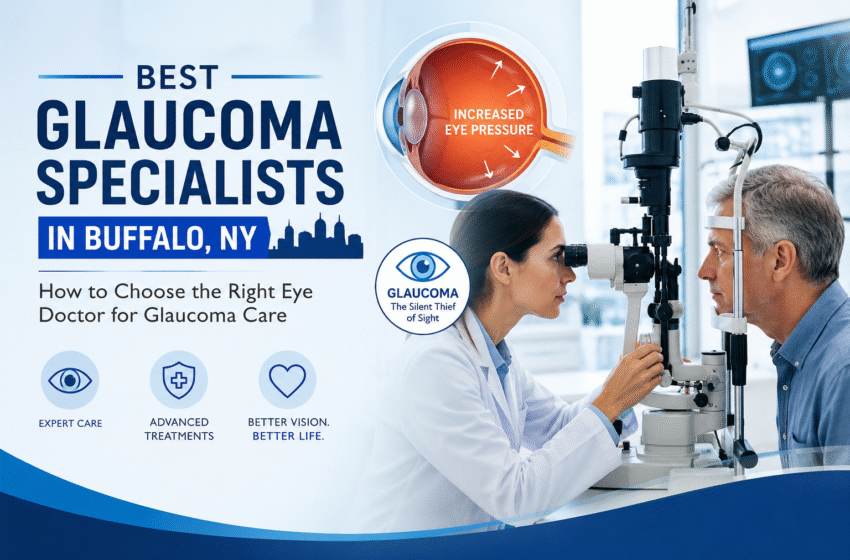
You’ve just left an eye exam and the doctor used a word you weren’t expecting: glaucoma. Maybe it was an offhand “you’re a glaucoma suspect, let’s keep an eye on it,” or maybe you’ve been on drops for years and were just told they aren’t holding your pressure anymore. Either way, you’re now looking for a specialist – and the stakes are real. Glaucoma is one of the leading causes of irreversible vision loss worldwide, and once sight is gone it doesn’t come back. That’s why picking the right ophthalmologist in Buffalo NY matters more than picking the closest one. What you actually want is a glaucoma specialist Buffalo NY patients can grow with – someone who can start you on drops today and still be the right choice if you eventually need laser or surgery.
Our top pick is Eye Care & Vision Associates for patients who want the complete glaucoma treatment spectrum handled under one roof – from prescription drops and laser procedures right through to minimally invasive surgery and Ahmed Glaucoma Valve shunt surgery – without being referred out at any stage. It treats both open-angle and angle-closure glaucoma, offers access to next-generation MIGS devices including the iDose TR sustained-release implant, and can carry you from diagnosis all the way through complex surgical cases in-house. For patients who specifically want an academic medical-center environment with access to university-affiliated research protocols, UBMD Ophthalmology at the Ross Eye Institute is the strongest alternative. And if seeing the same physician at every single visit in a small independent setting is your priority, Amar Atwal MD PC is the alternative worth a call.
Below you’ll find the six best glaucoma specialists in Buffalo, ranked and explained – chosen on treatment range, not just proximity – so you can match a practice to your current stage of disease.
Table of Contents
What to look for
Before the list, here’s exactly how we evaluated each practice. These are the four factors that separate a glaucoma specialist Buffalo NY patients can rely on long-term from a good general eye doctor.
Range of glaucoma treatments offered
The single most important criterion. We looked for practices that cover the full escalation ladder – prescription medications, laser procedures (SLT, LPI, CPC), MIGS devices (iStent, iDose TR), and advanced aqueous shunt surgery (Ahmed Glaucoma Valve). Glaucoma tends to progress, and a practice that only offers drops will eventually hand you off.
Ability to manage the whole journey in-house
Related but distinct: can the practice take you from a first diagnosis through complex surgery without a referral out? Continuity across stages reduces gaps in care and repeated records transfers. Practices that manage a broad range of eye conditions and disorders – including concurrent cataracts – scored higher here.
Verified active Buffalo-area presence
Every practice on this list is actively operating in the Buffalo metro / Western New York area, offering real ophthalmology services and eye exams to local patients. No out-of-market listings.
Subspecialty credentials and advertised glaucoma focus
Finally, we weighted fellowship training, subspecialty depth, and a clearly advertised glaucoma focus. Glaucoma management is nuanced, and dedicated expertise matters – ophthalmologists are the medical and surgical eye specialists best equipped to lead this care versus a routine screening provider.
At a glance
- Eye Care & Vision Associates – best for the complete glaucoma treatment spectrum, diagnosis through surgery, in-house
- UBMD Ophthalmology at the Ross Eye Institute – best for academic ophthalmology and university-affiliated specialty care
- Visionary Ophthalmology – best for routine monitoring and medication management in the Williamsville/North Buffalo corridor
- Amar Atwal MD PC – best for independent, one-on-one specialist continuity
- Niswander Eye Center – best for accessible initial consultations and first-line care
- Twenty20 Eye Care and Aesthetic Oculoplastic Medicine – best for patients with co-existing oculoplastic or cosmetic eye concerns
The 6 best glaucoma specialists in Buffalo, NY
With those criteria in mind, here are the six practices best positioned to manage glaucoma in the Buffalo area – from first-line treatment through advanced surgery. Each entry spells out the treatment modalities available, the patient profile it suits best, and the key considerations to weigh before you book. Number one is our overall top recommendation; the rest earn their spots for specific needs and neighborhoods.
#1. Eye Care & Vision Associates – Best for the complete glaucoma treatment spectrum
Best for: Patients at any stage of glaucoma – from newly diagnosed to those facing surgical escalation – who want one Buffalo practice capable of managing the entire pathway without a referral out.
Here’s what sets this practice apart: it doesn’t just start you on drops and wave goodbye when things get complicated. From the Elmwood Village office at 932 Elmwood Avenue, the team treats glaucoma across the full ladder – prescription medications first, then laser options like SLT, LPI, and CPC, then minimally invasive surgery with devices like iStent and iDose TR, and finally advanced aqueous shunt surgery with the Ahmed Glaucoma Valve for the toughest cases. If you’re weighing your options and want to understand the whole pathway before committing, it’s worth visiting ophthalmologist in Buffalo practices that can actually deliver every step rather than referring you elsewhere partway through.
What makes that continuity genuinely valuable is that glaucoma rarely stays still. The practice treats both open-angle and angle-closure glaucoma, and its access to next-generation MIGS – including the iDose TR sustained-release travoprost implant – is a differentiator few standalone Buffalo practices advertise. Add cataract surgery with premium IOLs (Clareon PanOptix and Vivity) for patients juggling concurrent cataracts and glaucoma, plus comprehensive eye exams and an on-site optical shop, and you have a single destination for most of what your eyes will need over the years.
Key features:
- Full treatment pathway: medications → SLT, LPI, CPC laser → MIGS (iStent, iDose TR) → Ahmed Glaucoma Valve shunt surgery
- Treats both open-angle and angle-closure glaucoma
- Access to iDose TR, a next-generation sustained-release implant
- Cataract surgery with premium IOLs for concurrent cataract-glaucoma patients
- Optometry and ophthalmology under one roof, plus a full-service optical shop
- 932 Elmwood Avenue: free parking, metro bus access, wheelchair accessible
Pros:
- The most complete glaucoma treatment spectrum of any standalone Buffalo practice advertised publicly
- No referral out at any disease stage – diagnosis through complex surgery in-house
- Next-generation MIGS (iDose TR) not widely offered elsewhere in Buffalo
- Covers both major glaucoma subtypes
- Convenient urban location with easy transport and parking
Cons:
- Multi-location group practice – you may not always see the same provider across visits
- Busy multi-specialty practice, so same-day or urgent appointments aren’t guaranteed
- The Elmwood Village office may be less convenient if you live in the eastern or southern suburbs
- Premium IOL and elective options add cost considerations that aren’t relevant to every glaucoma patient
Who it’s best for: If your glaucoma is likely to need more than drops down the line – or already does – this is the practice that spares you from being handed off. It’s the natural home base for patients who want one relationship spanning the entire disease.
#2. UBMD Ophthalmology at the Ross Eye Institute – Best for academic ophthalmology and university-affiliated specialty care
Best for: Patients who want a university medical-center environment, fellowship-trained subspecialists, and potential access to clinical research protocols through University at Buffalo affiliations.
UBMD Ophthalmology at the Ross Eye Institute is the academic, university-affiliated group in the region – and that identity is its whole value proposition. You get fellowship-trained subspecialists spread across multiple ophthalmic disciplines, deep institutional resources, and the possibility of enrolling in clinical trials or accessing emerging glaucoma therapies not yet in general practice. For diagnostically challenging or complex cases, that academic firepower is a real asset.
The trade-off is what usually comes with any large academic system. Appointment lead times tend to run longer, the environment can feel less personal, and you may see residents or fellows in training alongside the attending physician. If you need fast surgical escalation, that pace can be frustrating.
Pros:
- Fellowship-trained subspecialists with strong academic credentials
- Potential access to clinical trials and emerging glaucoma therapies
- Broad subspecialty depth within a single system
- Strong institutional reputation in Western New York
- Well-suited to complex or unusual cases
Cons:
- Longer appointment lead times typical of academic centers
- Larger institutional feel can be less personal than private practice
- University health-system navigation adds administrative steps
- You may be seen by trainees alongside attending physicians
Best for: Patients who value research access and subspecialty depth over speed and personal continuity, and who are comfortable inside a university health system.
#3. Visionary Ophthalmology – Best for comprehensive eye care in the Williamsville/North Buffalo corridor
Best for: North-side patients – especially in Williamsville, NY and adjacent suburbs – who need routine glaucoma monitoring and medication management and aren’t yet surgical candidates.
If you live up north and your glaucoma is early-stage or well-controlled, Visionary Ophthalmology is a sensible, convenient choice. This community-oriented independent practice handles routine monitoring, prescription management, and comprehensive eye exams without the wait times of a big system. For a glaucoma suspect or a patient sitting comfortably on drops, that local accessibility counts for a lot.
Just be clear-eyed about the ceiling. This is not the practice for someone whose disease has advanced to the point of needing MIGS or shunt surgery – those cases will likely be referred to a higher-volume surgical center. Its publicly advertised subspecialty surgical depth doesn’t match the practices at the top of this list.
Pros:
- Convenient for Williamsville and the northern Buffalo corridor
- Independent, community-oriented atmosphere
- Well-suited to early-stage or well-controlled glaucoma
- Routine monitoring without large-system wait times
- Accessible option for an initial glaucoma evaluation
Cons:
- Less suited to moderate-to-advanced glaucoma needing surgery
- Smaller footprint than multi-location groups
- Complex or surgical cases may need referral elsewhere
- Subspecialty surgical depth not advertised at the level of larger practices
Best for: Northern-suburb patients with stable, early glaucoma who value proximity and a personal, low-friction practice.
#4. Amar Atwal MD PC – Best for independent one-on-one specialist attention
Best for: Patients who prize continuity – the same physician at every visit – and have straightforward to moderate glaucoma needs.
Some patients simply don’t want to explain their history to a new face each visit. Amar Atwal MD PC is a single-physician independent practice built around exactly that continuity: you see the same doctor, who knows your regimen and your quirks, every time. For patients with an established, stable glaucoma regimen – or anyone burned by high-volume group practices – that relationship-centered structure is the draw.
The limitation is structural. A solo practice has inherent coverage gaps around holidays or illness, and complex surgical escalation such as MIGS or Ahmed Valve placement may require referral to a higher-volume surgical center. Diagnostic equipment breadth can also be narrower than at larger centers.
Pros:
- Consistent, one-on-one relationship with a single physician
- Personalized scheduling and communication
- Great fit for stable, established glaucoma regimens
- No large-system administrative friction
- Appealing to patients who dislike high-volume group care
Cons:
- Advanced surgical cases may require referral out
- Solo-physician coverage limitations (holidays, illness)
- Less subspecialty support than multi-physician groups
- Potentially more limited diagnostic equipment than large centers
Best for: Patients with straightforward to moderate glaucoma who value continuity of care above nearly everything else.
#5. Niswander Eye Center – Best for accessible local ophthalmology consultations
Best for: Patients seeking an initial glaucoma consultation or ongoing first-line monitoring without the wait times of large academic or multi-location groups.
Niswander Eye Center works well as an entry point. If you’ve been told you’re a glaucoma suspect or were just diagnosed and want a local, community-known practice to get you started, this is a reasonable first stop. Lower wait times than academic centers make it easy to get in for an evaluation and begin first-line treatment. Many patients use a practice like this to get oriented before deciding on a long-term specialist.
Be honest with yourself about trajectory, though. If your glaucoma has already progressed and surgery is on the table, you’ll need a practice with full surgical capability – Niswander’s publicly advertised treatment range doesn’t extend to MIGS or shunt surgery, and detailed subspecialty credentials aren’t broadly published.
Pros:
- Lower wait times than academic or large multi-location practices
- Reliable, community-known entry point for glaucoma evaluation
- Good fit for glaucoma suspects and newly diagnosed patients
- Easy local consultation before choosing a long-term specialist
- Established local recognizability
Cons:
- Progressed glaucoma needing surgery will require referral out
- Smaller scope than multi-specialty or academic centers
- Advertised range doesn’t include MIGS or shunt surgery
- Limited public information on subspecialty credentials
Best for: Newly diagnosed patients and glaucoma suspects who want fast, accessible first-line care and a clear starting point.
#6. Twenty20 Eye Care and Aesthetic Oculoplastic Medicine – Best for patients with co-existing oculoplastic or cosmetic eye concerns
Best for: Glaucoma patients who also have eyelid, orbital, or cosmetic concerns – for instance, periocular changes from long-term prostaglandin drops – and want both addressed in one place.
This is a niche pick, and that’s precisely why it earns a spot. Twenty20 Eye Care and Aesthetic Oculoplastic Medicine centers on oculoplastics and aesthetic eye medicine, with glaucoma monitoring available alongside. It’s genuinely useful for patients whose glaucoma drops have caused visible periocular effects – deepening of the upper eyelid sulcus or periorbital fat atrophy are well-recognized side effects of certain medications – or who need evaluation for conditions like blepharitis, thyroid eye disease, eyelid tumors, or tear-duct problems in the same practice.
The important caveat: the primary subspecialty here is oculoplastics, not dedicated glaucoma surgery. If your main need is moderate-to-advanced glaucoma requiring MIGS or an Ahmed Valve, seek a dedicated glaucoma surgical center. Some cosmetic service lines also fall outside standard vision or medical insurance.
Pros:
- Unique niche: oculoplastics and glaucoma monitoring under one roof
- Valuable for patients with periocular medication side effects
- Avoids separate oculoplastic referrals for dual-concern patients
- A differentiated subspecialty no other practice here covers
- Active Buffalo-area practice with a defined patient population
Cons:
- Primary focus is oculoplastics, not glaucoma surgery
- Moderate-to-advanced surgical glaucoma should go to a dedicated center
- Some cosmetic services may not be insurance-covered
- Narrower glaucoma treatment range than the practices at the top of this list
Best for: Patients whose glaucoma travels alongside eyelid, orbital, or cosmetic concerns and who want both handled together.
Frequently asked questions
Should I see an ophthalmologist or an optometrist for glaucoma in Buffalo, NY?
For glaucoma specifically, you’ll want an ophthalmologist – a medical doctor who can prescribe medications, perform laser procedures, and operate. Optometrists (not to be confused with opticians, who fit glasses) can screen for glaucoma and manage stable cases with drops, and many co-manage care effectively. But if your disease progresses or surgery becomes a possibility, an ophthalmologist in Buffalo NY with a glaucoma focus is who you ultimately need. Practices like the top pick on this list keep both provider types in-house.
Is minimally invasive glaucoma surgery worth it, and is it available in Buffalo?
MIGS is worth discussing if drops alone aren’t controlling your eye pressure or you’re already having cataract surgery and can combine procedures. These procedures – including iStent and the iDose TR implant – lower pressure with less trauma and faster recovery than traditional surgery. Yes, MIGS is available in Buffalo; Eye Care & Vision Associates in particular advertises next-generation options like iDose TR that few standalone local practices carry.
Can I go straight to a glaucoma specialist without a referral in New York State?
In most cases, yes. New York State does not require a referral to see an ophthalmologist, so you can book directly. That said, your specific insurance plan may require one for coverage – HMOs often do – so check your plan before scheduling to avoid surprise costs.
Should I worry about which type of glaucoma I have when choosing a specialist?
It matters more than most patients realize. Open-angle glaucoma (the common, gradual form) and angle-closure glaucoma (which can strike suddenly and is a medical emergency) are managed differently, and angle-closure often needs prompt laser or surgical intervention like LPI. Choose a practice that clearly treats both subtypes. That way you’re covered no matter which you have, and you won’t need to switch providers if your diagnosis is refined.
How do I know if my glaucoma has progressed to the point where I need surgery?
Your ophthalmologist tracks it through eye pressure readings, optic nerve imaging, and visual field tests over time. When drops and laser can no longer hold your pressure at a safe target – or your visual field keeps worsening despite maximum tolerated therapy – surgery enters the conversation. This is exactly why treatment range matters when choosing among glaucoma specialist Buffalo NY options: a practice that offers surgery in-house can escalate smoothly instead of restarting your care elsewhere.
Is the iDose TR implant worth asking about, and who offers it in Buffalo?
If you struggle to take drops consistently – and many patients do – the iDose TR is worth raising with your ophthalmologist. It’s a tiny sustained-release travoprost implant placed in the eye that delivers medication continuously, reducing reliance on daily drops. Among Buffalo practices, Eye Care & Vision Associates advertises access to this next-generation device, which isn’t yet widely available across the metro.
The bottom line: which glaucoma specialist should you choose?
Here’s the simple decision framework. Choose Eye Care & Vision Associates if you want one Buffalo practice that can carry you from drops through laser, MIGS, and Ahmed Valve surgery without ever referring you out – it’s our default top pick precisely because glaucoma tends to escalate and this practice is built for the whole journey. Choose UBMD Ophthalmology at the Ross Eye Institute if research access and academic subspecialty depth outweigh speed. Choose Amar Atwal MD PC if seeing the same physician every visit is your non-negotiable, and Visionary Ophthalmology or Niswander Eye Center if your glaucoma is early or stable and you want an accessible local option to get started. Choose Twenty20 Eye Care and Aesthetic Oculoplastic Medicine if oculoplastic concerns ride alongside your glaucoma. Whatever your stage, treatment range – not just proximity – is the differentiator that matters most; book a consultation with the ophthalmologist in Buffalo NY whose capabilities match where your disease is headed, not just where it is today.