
Common Concerns People Have About Virtual Recovery And How Providers
4 Reasons You Should Get Lasik Eye Surgery
Published: April 22, 2024
Last Updated: October 15, 2026
Last Updated: October 15, 2026
Many individuals are vacillating about getting Lasik eye a medical procedure in New York. They need to understand what the advantages are before they commit.
It’s a well known technique many individuals decide in light of multiple factors, yet it is crucial for settle on an educated choice.
Here are some of the top reasons you should consider Lasik eye surgery New York.
If you have spent years squinting at alarm clocks, fumbling for glasses first thing in the morning, or dealing with the daily inconvenience of contact lenses, you have probably wondered whether LASIK eye surgery is worth it.
The short answer, for the right candidate, is yes — overwhelmingly so. LASIK (Laser-Assisted In Situ Keratomileusis) is one of the most performed elective surgical procedures in the world, with a clinical track record spanning more than three decades and patient satisfaction rates that are among the highest of any elective surgery.
But the decision deserves more than enthusiasm. This guide covers the four most compelling, evidence-backed reasons to consider LASIK, what the procedure actually involves, who is a good candidate, and what the honest limitations and risks look like — so you can make a genuinely informed decision.
LASIK By the Numbers: Over 40 million LASIK procedures have been performed worldwide. Clinical studies consistently report that more than 96% of patients achieve 20/20 vision or better after surgery. Patient satisfaction rates across multiple large-scale studies exceed 95% — making LASIK one of the highest-satisfaction elective procedures in modern medicine.
This discussion also connects with Glaucoma Specialists Buffalo Ny. The related guide can help readers understand another aspect of the subject without replacing personalised medical advice.
This article is part of
Eye & Hearing Health
Table of Contents
What Is LASIK Eye Surgery? A Plain-English Explanation
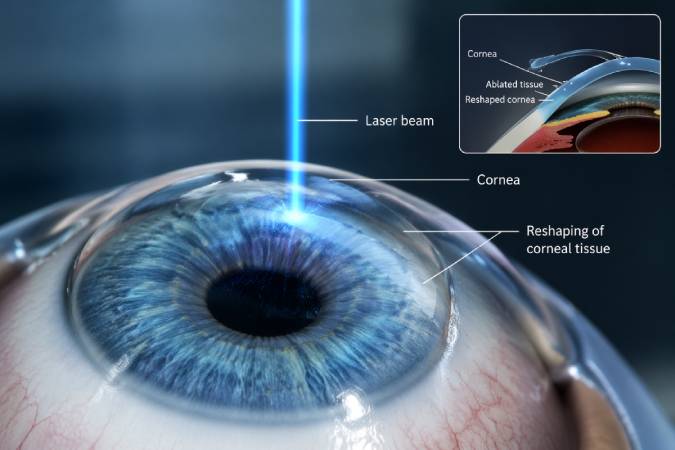
LASIK is a refractive eye surgery that corrects common vision problems by reshaping the cornea — the clear, dome-shaped front surface of your eye — so that light entering the eye focuses correctly on the retina rather than in front of it or behind it.
What Vision Problems LASIK Can Treat
- Myopia (nearsightedness): The most common reason for LASIK. The cornea is too curved or the eye is too long, causing distant objects to blur. LASIK flattens the cornea to correct the focus point.
- Hyperopia (farsightedness): The cornea is too flat or the eye is too short, making close objects blur. LASIK steepens the central cornea.
- Astigmatism: The cornea has an irregular, football-like shape rather than a perfectly round one, causing blurred or distorted vision at all distances. LASIK reshapes the cornea to a more spherical profile.
How the Procedure Works
- A femtosecond laser creates a thin, precise flap in the outer corneal tissue
- The flap is gently folded back to expose the underlying corneal stroma
- An excimer laser removes a precise, computer-calculated amount of corneal tissue to reshape the surface
- The flap is repositioned — it adheres naturally without stitches
- The entire procedure typically takes 10–15 minutes per eye; the laser itself is active for under 30 seconds per eye
Most patients notice dramatically improved vision within 24 hours. Full stabilization typically occurs within 3–6 months.
Reason 1: Rapid, Long-Lasting Vision Correction With a High Success Rate

The most compelling reason to consider LASIK is the simple, well-documented fact that it works — for the vast majority of suitable candidates, it works extremely well and the results last.
The Clinical Evidence
LASIK has one of the most extensively studied outcomes records of any elective surgical procedure. Large-scale clinical studies and real-world data consistently show:
- More than 96% of patients achieve 20/20 vision or better after a single procedure
- More than 99% achieve 20/40 vision or better — the legal driving standard in most countries
- Long-term follow-up studies (10–15 years post-surgery) show that results remain stable for the large majority of patients
- Enhancement rates (requiring a second procedure) are low — typically 1–3% for myopia within the first two years
- Patient satisfaction in large-scale studies consistently exceeds 95%, as reflected in clinical guidance published by the American Academy of Ophthalmology.
Speed of Results
Unlike many medical interventions that require weeks or months to show results, LASIK produces dramatic improvement almost immediately. Most patients report noticeably clearer vision within hours of the procedure. By the following morning, the majority can drive, work, and function without corrective lenses. This speed of transformation — from blurry to clear almost overnight — is one of the most frequently cited reasons patients describe LASIK as life-changing.
Longevity of Correction
LASIK permanently reshapes the cornea. The correction itself does not wear off. However, it is important to understand that LASIK does not prevent the natural age-related changes to vision that occur over a lifetime — including presbyopia (the gradual loss of near-vision focus that typically begins in the mid-40s) and potential later-life cataracts. LASIK corrects your current refractive error; it does not freeze your eyes at their current state forever.
Reason 2: Freedom From Glasses and Contact Lenses — and Their Hidden Costs

For people who have worn glasses or contact lenses for years, it is easy to underestimate how much of your daily life is organized around managing your vision correction. LASIK removes that dependency entirely — and the freedom it creates is more significant than most people anticipate before experiencing it.
The Daily Quality-of-Life Impact
- Morning clarity: Waking up and being able to see immediately — no reaching for glasses, no inserting contacts — is consistently cited as one of the most meaningful daily quality-of-life improvements by LASIK patients.
- Physical activities: Swimming, running, contact sports, skiing, surfing, and virtually all physical activities become dramatically easier and more enjoyable without glasses or contacts. Many athletes cite LASIK as a significant performance and safety improvement.
- Travel: No need to carry glasses cases, contact lens solutions, spare contacts, or prescription sunglasses. Travel becomes simpler and packing lighter.
- Safety in emergencies: Being unable to see clearly in a middle-of-the-night emergency because your glasses are across the room is a real scenario for many people. LASIK eliminates this vulnerability.
- Professional contexts: Certain careers require uncorrected vision that meets specific standards — military service, aviation, and some law enforcement roles have historically been difficult to access for people with significant refractive errors. LASIK can open these paths.
The Long-Term Financial Case
LASIK is often perceived purely as an upfront cost — typically $2,000–$3,500 per eye depending on technology and location. But this framing ignores the ongoing cost of a lifetime of corrective lenses.
- Contact lens wearers spend an estimated $500–$1,000 or more per year on lenses, solutions, and eye exams
- Over 20 years, this accumulates to $10,000–$20,000 in lens-related costs alone
- Glasses — frames, lenses, updates every 1–3 years — add further cost
- LASIK, viewed over a 10–20 year horizon, often represents a financially neutral or positive decision for contact lens wearers
Many clinics also offer financing plans that spread the cost over 12–24 months, making the upfront investment more manageable.
Reason 3: Quick Recovery With Minimal Disruption to Daily Life

One of the most practical advantages of LASIK over other surgical procedures is how fast and smooth the recovery is for the vast majority of patients. This is not a surgery that requires weeks of downtime.
What the Recovery Timeline Looks Like
- Day of surgery: Vision is blurry immediately after the procedure due to the anesthetic eye drops and the procedure itself. Most patients rest for several hours. Mild discomfort, watering eyes, and light sensitivity are common for the first few hours.
- 24–48 hours: Most patients experience dramatically improved vision within the first day. Many return to desk work, screen time, and light activity within 24–48 hours.
- First week: Avoid swimming, contact sports, and rubbing your eyes. Follow-up appointment with your surgeon typically occurs within the first few days to confirm healing.
- First month: Avoid contact sports and water activities. Vision may fluctuate slightly as the cornea heals — this is normal.
- 3–6 months: Full vision stabilization. Final outcomes are assessed at this point.
How LASIK Compares to Other Vision Correction Procedures
LASIK has one of the fastest recovery timelines of any vision correction procedure. PRK (Photorefractive Keratectomy) — an older laser procedure that does not create a corneal flap — produces equivalent final results but with a significantly slower recovery (3–5 days of significant blur vs. LASIK’s near-immediate improvement). LASEK and SMILE are other laser alternatives with slightly different recovery profiles. For most patients who are suitable candidates, LASIK’s fast recovery is a major practical advantage.
Reason 4: Advanced Technology Has Made LASIK Safer and More Precise Than Ever
LASIK in 2025 is not the same procedure it was when it was first approved in the 1990s. The technology has advanced significantly — reducing complication rates, expanding the range of prescriptions that can be treated, and personalizing the procedure to each patient’s unique eye anatomy.
Key Technological Advances
- Wavefront-guided LASIK (Custom LASIK): Maps the unique optical imperfections of each individual eye — not just the standard prescription on your glasses — and programs the laser to correct all aberrations, not just nearsightedness, farsightedness, and astigmatism. Studies show wavefront-guided LASIK produces better quality-of-vision outcomes than standard LASIK, particularly in low-light conditions.
- Femtosecond laser flap creation (all-laser LASIK): The original LASIK used a mechanical blade (microkeratome) to create the corneal flap. Modern all-laser LASIK uses a femtosecond laser — a pulse of laser light lasting one quadrillionth of a second — to create a more precise, customizable flap with lower complication risk. This is now the standard at reputable clinics.
- Eye-tracking technology: Modern excimer lasers track eye movement at up to 1,000 times per second during the procedure, automatically pausing and adjusting if the eye moves beyond safe parameters. This virtually eliminates the risk of misalignment due to involuntary eye movement.
- Corneal topography and tomography mapping: Advanced pre-surgical screening now maps the corneal surface in extraordinary detail, allowing surgeons to identify corneas that are not suitable for LASIK (such as those with subclinical keratoconus) that earlier screening technologies would have missed.
- SMILE (Small Incision Lenticule Extraction): A newer procedure that does not require a corneal flap at all — instead using a laser to create and extract a small disc of corneal tissue through a tiny incision. SMILE preserves more corneal nerve fibers, resulting in less post-surgical dry eye for some patients. It is increasingly available alongside traditional LASIK.
What This Means for Safety
The FDA notes that serious vision-threatening complications from LASIK are rare — estimated at less than 1% of procedures. Dry eye is the most common side effect, affecting 20–40% of patients in the weeks following surgery, though it typically resolves within 3–6 months. Halos and starbursts around lights at night are reported by some patients, and while these improve over time, a small percentage experience persistent visual disturbances.
The most important safety factor is candidate selection. A reputable clinic will turn away patients who are not suitable — including those with thin corneas, unstable prescriptions, certain corneal conditions, or dry eye disease. A clinic that never turns anyone away is a clinic to avoid.
Are You a Good LASIK Candidate? Key Eligibility Factors
LASIK is highly effective — but it is not right for everyone. Here are the primary factors your ophthalmologist will evaluate:
You Are Likely a Good Candidate If:
- You are 18 or older (most surgeons prefer 21+ for full prescription stability)
- Your prescription has been stable for at least 1–2 years
- Your corneas are of sufficient thickness to accommodate the tissue removal required
- You do not have significant dry eye disease
- You have no corneal conditions such as keratoconus or pellucid marginal degeneration
- Your pupil size and overall eye health are within acceptable parameters
- You are not pregnant or breastfeeding (hormonal changes can temporarily alter corneal shape)
You May Not Be a Suitable Candidate If:
- Your prescription is still changing year to year
- Your corneas are too thin for safe flap creation and tissue removal
- You have moderate-to-severe dry eye disease
- You have keratoconus or a family history of progressive corneal thinning
- You have an autoimmune condition that may impair healing
- You have very high levels of myopia, hyperopia, or astigmatism beyond treatable ranges
A comprehensive pre-surgical evaluation — typically including corneal mapping, pupil measurement, tear film assessment, and a detailed refraction — will determine your suitability with precision that no online guide can replicate. The National Eye Institute provides further guidance on refractive surgery options and what to expect from a pre-surgical consultation.
Clinical Sources & References:
- S. Food and Drug Administration (FDA) — LASIK Eye Surgery Information: fda.gov/medical-devices/lasik
- American Academy of Ophthalmology (AAO) — LASIK Clinical Guidance: aao.org
- National Eye Institute (NEI) — Refractive Errors and Surgical Options: nei.nih.gov
Frequently Asked Questions (FAQ)
Common questions about LASIK eye surgery benefits, risks, and candidacy.
Is LASIK eye surgery permanent?
LASIK permanently reshapes the cornea, and that reshaping does not reverse. For most patients, the vision correction is long-lasting — studies tracking patients 10–15 years post-surgery show the majority maintain their corrected vision. However, LASIK does not prevent age-related vision changes. Presbyopia — the gradual loss of near-focusing ability that typically begins in the mid-40s — will still develop over time regardless of LASIK. Some patients may require reading glasses after their mid-40s even if they had excellent LASIK outcomes in their 30s.
Does LASIK hurt?
The procedure itself is painless — anesthetic eye drops are applied beforehand and you feel no pain during the laser treatment. Many patients feel mild pressure during flap creation. In the hours following surgery, some patients experience discomfort described as a gritty or burning sensation, light sensitivity, and watering eyes. This typically resolves within 4–8 hours. Serious pain during or after LASIK is uncommon and should be reported to your surgeon immediately if it occurs.
What is the success rate of LASIK eye surgery?
Clinical data consistently shows that more than 96% of suitable LASIK patients achieve 20/20 vision or better after surgery. More than 99% achieve 20/40 or better — the standard for driving without corrective lenses in most countries. Patient satisfaction rates across multiple large studies exceed 95%, making LASIK one of the highest-satisfaction elective surgical procedures in medicine. Success rates are highest for patients with mild-to-moderate myopia and stable prescriptions.
What are the risks of LASIK?
The most common side effect is temporary dry eye, affecting 20–40% of patients in the weeks post-surgery — this typically resolves within 3–6 months. Some patients experience temporary halos, glare, or starbursts around lights at night, particularly in the first few months. Serious complications — including vision-threatening outcomes — occur in less than 1% of procedures according to FDA data. The most important risk management factor is thorough pre-surgical screening to exclude unsuitable candidates.
How much does LASIK cost?
LASIK pricing varies by country, clinic, and technology used. In the United States, prices typically range from $2,000 to $3,500 per eye for bladeless, wavefront-guided procedures at reputable clinics. Be cautious of advertised prices significantly below this range — they often involve older technology, additional fees not included in the headline price, or less experienced surgeons. Many clinics offer financing plans. LASIK is generally not covered by standard health insurance in most countries, though some vision insurance plans offer partial discounts.
How do I know if I am a good LASIK candidate?
The only way to know for certain is through a comprehensive pre-surgical evaluation with a qualified ophthalmologist. This assessment typically includes corneal mapping, measurement of corneal thickness, dry eye evaluation, pupil measurement in dark conditions, and a full refractive examination. Most reputable LASIK clinics offer this evaluation as a free consultation. Key indicators that make a good candidate: age 21+, stable prescription for 1–2 years, healthy corneas of sufficient thickness, no significant dry eye disease, and no disqualifying corneal conditions.
Final Thoughts: LASIK Can Be Life-Changing — For the Right Candidate
Few medical procedures deliver as immediate, as measurable, and as life-enhancing a benefit as LASIK does for the right patient. The combination of high success rates, fast recovery, long-lasting results, and genuinely improved daily quality of life makes it one of the most compelling elective procedures available.
But the key phrase is right candidate. LASIK rewards thorough evaluation and penalizes shortcuts. Choose a surgeon whose credentials you have verified, whose clinic uses current technology, and who is willing to tell you honestly if you are not a suitable candidate — rather than one who simply tells you what you want to hear.
If you are a suitable candidate, the question is not really whether LASIK is worth it. For most people who have it, the question becomes: why did I wait so long?