
Nivara Lab Grown Diamonds: India’s Complete Buyer’s Guide (2026)
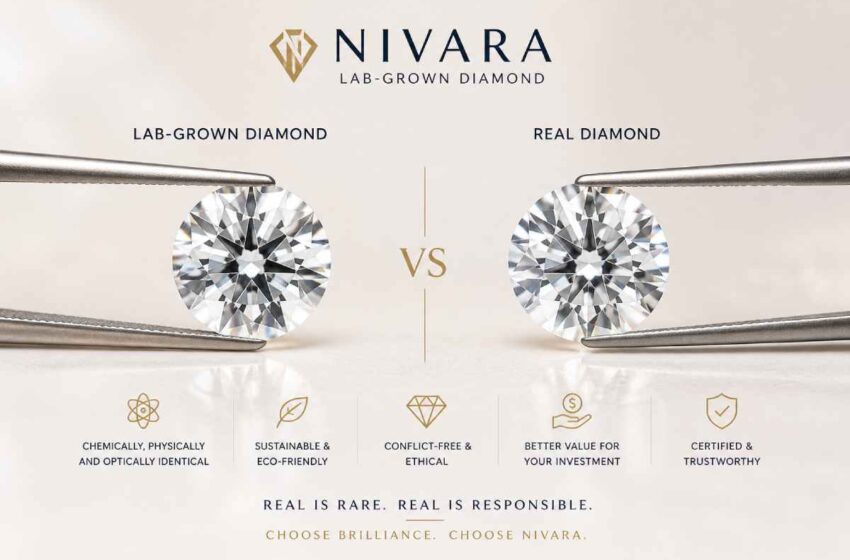
Most people walk into a diamond store with a budget in one hand and a vague sense of guilt in the other.
The guilt part is real. Somewhere between the Instagram proposal reels and the jewellery store lighting, a quiet question sits: where did this actually come from, and what did it cost — not in rupees, but in everything else?
That’s the question Nivara lab grown d were built to answer.
Not with a marketing brochure. With an IGI certificate, a laser-inscribed stone, and a price that doesn’t require you to quietly recalculate your savings for six months.
This guide covers everything you need before you buy — what lab grown diamonds actually are, how Nivara’s approach works, what the certification means, what things cost in India in 2026, and the one step most buyers skip that protects them completely.
Table of Contents
Quick Summary — What You Need to Know
- Nivara lab grown diamonds are in fact real diamonds that are Certified by IGI, no the lab grown diamonds are not simulants or cubic zirconia.
- They cost 60–80% less than mined diamonds of the same size and grade.
- India’s lab grown diamond market hit USD 453.7 million in 2026 and is growing at 14.8% annually.
- A new BIS standard (IS 19469:2025) now legally governs how retailers must label lab grown stones in India.
- Always verify your IGI certificate number on the IGI website before — or right after — buying.
So, What Exactly Is a Lab Grown Diamond?
Here‘s the short story: it really is a diamond. Same carbon, same crystal structure, same hardness, the only difference being that it‘s grown in a lab a few weeks, not under-ground for a few billion.
The longer version is that scientists figured out how to recreate the conditions of diamond formation — extreme pressure, extreme heat — inside a controlled environment. The result is a stone that is chemically, physically, and optically identical to a mined one. Not similar. Identical.
The International Gemological Institute (IGI), which grades most lab grown diamonds sold in India, is emphatic about this: even trained gemologists cannot tell a lab grown diamond from a mined one without specialised equipment. The certificate is what tells you which is which.
And since January 2026, India’s Bureau of Indian Standards has formalised this distinction through IS 19469:2025 — a standard that now legally requires retailers to label stones as “laboratory-grown diamond” or “laboratory-created diamond.” Terms like “cultured” or vague green-sounding phrases are no longer permitted. It’s a meaningful protection for buyers who previously had no regulatory backstop.
CVD and HPHT — The Two Ways a Lab Grown Diamond Gets Made
You’ll see these terms on your IGI certificate. Understanding them takes about two minutes and will make you a much more confident buyer.
CVD — Chemical Vapor Deposition
Think of this as building a diamond atom by atom from gas. A carbon-rich gas is heated inside a sealed chamber until it breaks apart. Carbon atoms then fall and attach — layer by layer — onto a thin diamond seed crystal sitting at the bottom. Over weeks, a full diamond forms.
CVD has completely overshadowed gem-quality diamond production worldwide. In fact, nearly all diamond stones you see being used in engagement rings, diamond jewellery brands, and what you‘ll find at brands like Nivara are in fact, CVD-grown diamonds.
HPHT — High Pressure High Temperature
This method goes the other direction — instead of building from gas, it mimics the Earth’s deep mantle. A diamond seed is placed inside a press and subjected to temperatures around 1,500°C and pressures that would make your head spin. Carbon crystallises around the seed, and a diamond forms.
HPHT is the older technology, developed back in the 1950s. It’s still widely used — particularly for producing fancy yellow diamonds and stones with D–F colour grades, where the method’s characteristics give it an edge.
For most buyers, the practical answer is: it doesn’t matter much which method was used. What matters is the 4Cs grade on the certificate. A VS1, E, Excellent cut CVD diamond and a VS1, E, Excellent cut HPHT diamond look identical in person and are priced similarly.
Lab Grown Diamond vs Natural Diamond — A Straight Comparison
Here’s the comparison most buyers are actually looking for:
| Factor | Lab Grown (IGI-Certified) | Natural Mined Diamond |
| Price (1 carat) | ₹30,000 – ₹70,000 | ₹2,00,000 – ₹3,00,000+ |
| Chemical makeup | Pure carbon — identical to natural | Pure carbon |
| Hardness | 10 on Mohs scale | 10 on Mohs scale |
| IGI/GIA certified | Yes | Yes |
| Conflict-free | Always | Depends on source & supply chain |
| Environmental footprint | Lower — especially with renewable energy | High mining impact, habitat disruption |
| Resale / buyback | Maturing; most good brands offer buyback | More established secondary market |
Price ranges are indicative for India, 2026. Source: Ivana Jewels Lab Grown Diamond Price Guide.
One thing the table doesn’t capture: the difference in what you can buy for the same money. A couple with a budget of ₹1,50,000 for a ring stone can afford a natural diamond of around 0.4–0.5 carats with modest clarity. The same budget buys a lab grown diamond of 1.5–2 carats, well-certified, with excellent cut and clarity. That’s not a marginal difference — it changes the entire conversation.
What Does a Lab Grown Diamond Actually Cost in India?
Lab grown diamond prices in India settled down throughout 2025–2026 after a sharp correction in 2022–2024 when oversupply pushed prices lower. The market has established a bottom, and buyers are acquiring true value today without the tumult experienced two years prior.
| Carat Weight | CVD (India, approx. 2026) | HPHT (India, approx. 2026) |
| 0.5 carat | ₹15,000 – ₹25,000 | ₹12,000 – ₹22,000 |
| 1 carat | ₹35,000 – ₹70,000 | ₹30,000 – ₹65,000 |
| 1.5 carat | ₹70,000 – ₹1,20,000 | ₹65,000 – ₹1,10,000 |
| 2 carat | ₹1,20,000 – ₹2,00,000 | ₹1,10,000 – ₹1,80,000 |
These are indicative ranges for loose IGI-certified stones in India as of 2026. Your final jewellery price will also include the gold or platinum setting, making charges, and 3% GST on jewellery — ask for a detailed breakdown before confirming any purchase.
India has a significant manufacturing advantage here. Surat processes a large share of global lab grown diamond output, which cuts down on import duties and middleman costs that buyers in other countries pay. A stone of comparable quality bought in the US or UK will cost more, often substantially so.
A note on larger stones: the savings get even more dramatic as you go up in carat. A 2-carat natural diamond with VS clarity and excellent cut can easily cross ₹10 lakh. A lab grown equivalent sits at ₹1.5–2 lakh. That’s the kind of gap that turns a once-in-a-lifetime purchase into something actually attainable.
The IGI Certificate — What It Is and Why You Must Have One
An IGI certificate is not a stamp of approval from the jeweller. It’s a report from an independent third-party lab that has examined the stone and recorded everything it found: carat weight, colour grade, clarity grade, cut grade, growth method (CVD or HPHT), and any treatments applied.
Finally, every certified lab grown diamond will have a report number laser inscribed on its girdle. That number should correspond to the report number written on the GIA diamond certificate. It‘s minuscule; so small you‘ll need a jeweler‘s loupe to see it, but if it‘s present, it permanently links the diamond to the certificate.
Here’s the verification step most buyers skip: go to the IGI website and enter the report number. The full grading report for that specific diamond appears on screen. Compare it against the physical or digital certificate you were given. If the details match, you have a verified, genuine stone. If there’s any discrepancy, stop the purchase immediately.
Nivara certifies every stone through IGI, no exceptions. That’s the baseline you should expect from any serious lab grown diamond brand in India. If a seller can’t produce an IGI or GIA certificate, or the number doesn’t appear in the database, those are not minor concerns — they’re dealbreakers.
Reading the 4Cs on Your Certificate
- Cut: The single most important factor for brilliance. Excellent or Very Good grades are what you want for jewellery. Avoid Good or below.
- Colour: Graded D through Z D–F being premium; G–H near-colourless & good value. Currently, most buyers will be unable to compare and see the difference between a D and a G.
- Clarity: Measures internal features. VS1–VS2 is a practical sweet spot — clean to the naked eye, well-priced. Flawless and Internally Flawless grades exist but command a significant premium for a difference most people will never see in daily wear.
- Carat: Weight, not size. A beautifully cut 1 carat stone will always look bigger than a badly cut 1 carat of equal weight. Don‘t go for Carat only.
Who Is Actually Buying Lab Grown Diamonds in India Right Now?
The honest answer is: many more kinds of people than you‘d think from reading the newspapers two years ago.
Young couples especially in metros such as Hyderabad, Bengaluru and Mumbai are perhaps the most visible segment. The equation is simple for these guys: they want a real diamond for a wedding or an engagement; they have a real budget and lab grown diamonds allow them to buy a stone that they would be happy with and not settle for something subpar.
But there’s a second group that often gets overlooked: buyers who specifically want conflict-free provenance. Natural diamonds have had a complicated supply chain history, and while the Kimberley Process has helped, it doesn’t satisfy everyone. Lab grown diamonds sidestep the question entirely.
A third group is the sustainability-conscious buyer — though this one comes with a caveat (more on that in the myths section below).
And then there are what you might call the practical luxury buyers — people who want diamond earrings or a pendant for everyday wear, not just special occasions, and who see no reason to spend natural-diamond prices for something they’ll wear to the office on a Wednesday.
Who Should Think Twice Before Buying
This guide would be doing you a disservice if it only listed reasons to buy. Here’s where you should slow down:
- Resale value is your priority: If you’re buying a diamond primarily to sell it later, lab grown is probably not the right choice yet. The secondary market is developing — many brands offer buyback or exchange programmes — but it’s not as established as the natural diamond market. Verify any buyback policy in writing before purchasing.
- You’re treating it as an investment: Diamonds in general are not strong financial investments. Natural diamonds have also seen significant value fluctuations over time. A lab grown diamond is something you wear, not a portfolio asset. Go in with that expectation.
- The seller can’t provide certification: No certificate equals no purchase. Full stop. There’s no reputable reason for a lab grown diamond not to have an IGI or GIA certificate in 2026.
Four Things People Get Wrong About Lab Grown Diamonds
“They’re not real diamonds”
This is the most persistent myth and the most wrong. A lab grown diamond is composed of pure carbon arranged in the diamond crystal lattice — the same as every diamond ever pulled from the ground. While the Federal Trade Commission in the US, GIA and IGI all identify them as being genuine diamonds. The term ‘synthetic’ on occasions causes confusion, but synthetic in this context should be understood as being formulated by synthesis and not faked.
“Lab grown = eco-friendly”
This needs unpacking. Growing diamonds in a lab requires substantial and sustained energy — the presses and reactors are not running on goodwill. Whether that energy comes from coal-fired grids or solar and wind makes an enormous difference to the actual environmental footprint. According to IGI notes, words such as “green” and “eco” do not apply equally to lab grown diamonds. If environmentally friendly products are essential to you, then inquire about the producer‘s methods of energy sources. Don‘t just let the marketing and advertising speak for itself;
“You can spot one by looking at it”
You cannot. This is not a matter of keen eyes or good lighting. Lab grown and mined diamonds are visually indistinguishable even under 10x magnification. Differentiating them requires specialised equipment that grading labs use — the kind of machines that cost hundreds of thousands of dollars and live in gemological laboratories, not jewellery stores.
“They have no resale value”
Overstated. The resale market is not as mature as natural diamonds, but it’s not zero either. Most good brands in India now offer exchange or buyback policies. The realistic framing is: buy a lab grown diamond because you want it and plan to keep it, not because you expect to flip it at a profit. Natural diamonds haven’t reliably delivered that either.
India’s Lab Grown Diamond Market in 2026 — What the Numbers Show
Lab grown diamond jewellery accounted for USD 453.7 million of the Indian market in 2026 and will by 2036, be worth USD 1,798.6 million (CAGR of 14.8%) according to Future Market Insights.
That‘s not hype it reflects several concrete developments happening right now:
- In December 2025, Titan Company unveiled “beYon ” its first dedicated lab grown diamond brand, with a dedicated store-in Mumbai. When India.biggest organized jeweller announces lab grown diamonds as a key growth pillar, it is not a trend but a structural change.
- The new BIS IS 19469:2025 standard, brought in from January 2026, defined consumer protections and defined terminology. It’s the regulatory foundation the market needed.
- Hyderabad, Bengaluru, Mumbai, and Delhi are all seeing rapid growth in dedicated lab grown diamond retail — both in physical stores and online.
- CVD technology now dominates gem-quality production in India. Surat’s manufacturing base makes Indian buyers some of the most cost-advantaged diamond customers in the world.
Before You Buy: A Practical Checklist
Run through these before confirming any lab grown diamond purchase in India:
- Ask for the IGI certificate number and verify it on the IGI website yourself — not through a link the seller provides.
- Check that the number on the certificate matches the laser inscription on the girdle.
- Confirm whether the stone is CVD or HPHT. Either is fine, but it must be stated.
- Look for a Cut grade of Excellent or Very Good. Good or below is not ideal for jewellery.
- Review the buyback and exchange policy in writing — not just verbally.
- Ensure your invoice includes the diamond’s IGI report number, the 4Cs details, the metal purity (18K or 22K gold), and making charges itemised separately.
- For custom jewellery, confirm lead times. Smaller stones (under 1 carat): typically 4–8 weeks. Stones above 2 carats: up to 12–24 weeks from growth to final setting.
Frequently Asked Questions
What makes Nivara lab grown diamonds different from other brands in India?
Nivara certifies every stone via the IGI. It is also completely customizable (diamond, metal and setting are ordered separately) and has physical shops in Hyderabad, Bangalore and Indore. Their USP is transparency its staff will talk you through the details of each stone and not use vague brand marketing jargon.
Are lab grown diamonds real diamonds?
Yes. They are made of pure carbon in the same crystal structure as a mined diamond. IGI, GIA, and every major gemological authority classify them as real diamonds. The difference is origin only.
How much does a Nivara lab grown diamond ring cost in India?
A solitaires of 1-carat IGI-certified stone will cost about 1,30,000–1,50,000 in Nivara (including gold and making charge). The loose stone alone will be about 35,000–70,000 depending on cut, color, clarity. Items like pendants, earrings and bangles start at a much lower price range.
Is IGI certification mandatory when buying a lab grown diamond?
It‘s not legally required but it should be your personal non-negotiable. You don‘t have any third party assurance of what you‘re buying without an IGI or GIA certificate. There is no valid excuse for any respectable retailer in 2026 to be selling any uncertified lab grown diamond.
Do lab grown diamonds pass a diamond tester?
Yes. A standard diamond tester measures thermal conductivity, and lab grown diamonds have the same thermal properties as natural diamonds. They test as real diamonds — because they are real diamonds.
What is the difference between CVD and HPHT diamonds in practical terms?
Very little for jewellery buyers. CVD dominates the Indian market and tends to produce clean, colourless stones. HPHT is slightly older and is often used for fancy yellow and D–F colour stones. For a given 4Cs grade, both methods produce a diamond of equivalent quality and similar price.
Final Thought
Here’s the honest version: Nivara lab grown diamonds are not for everyone, and this guide hasn’t tried to convince you otherwise.
If you want a real diamond, with verified quality, at a price that doesn’t require you to compromise on size or clarity or the metal around it — and you’re not buying it expecting to flip it for profit later — then a lab grown diamond from a brand like Nivara is a genuinely good choice. The science is sound. The regulation is now in place. The certification process is rigorous. And the savings are real.
The one thing you must do, regardless of where you buy: verify that IGI certificate number yourself. It takes sixty seconds and it’s the difference between knowing exactly what you have and just hoping for the best.
Explore Nivara’s full collection at nivara.diamonds. Every stone carries an IGI certificate — and now you know exactly how to read it.