
What to Know Before Buying a Smith Machine for Your Home Gym
Last Updated: October 16, 2026
A Smith machine is one of the more polarizing pieces of equipment in strength training, generating strong opinions in both directions from coaches and lifters who have used them extensively. The debate about whether they belong in a serious training program often obscures a more practical question: for a home gym specifically, does a Smith machine make sense for your goals, your space, and your training situation? The answer is more nuanced than the polarized discourse around them suggests, and it depends on factors that are specific to how you train and what you are trying to accomplish.
Table of Contents
What a Smith Machine Actually Is and How It Works
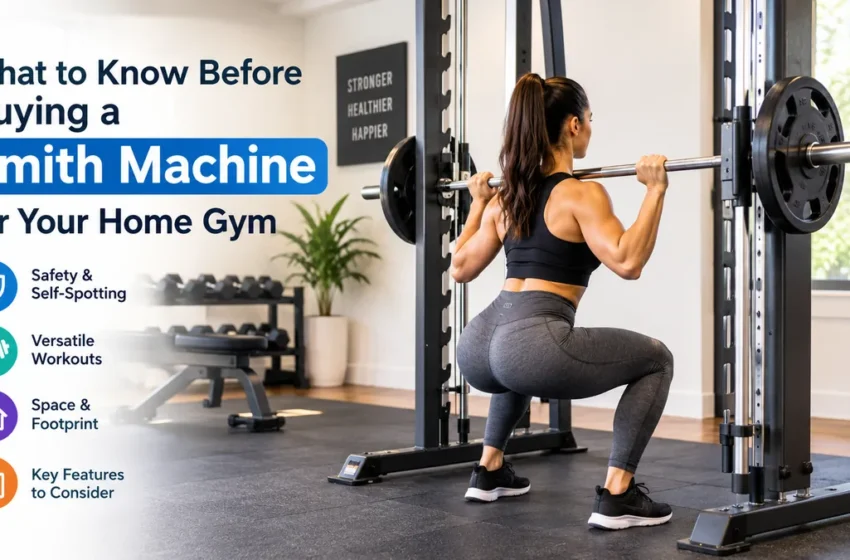
A Smith machine is a barbell mounted on vertical or angled rails that constrain the bar to a fixed path of movement. The bar slides along the rails and can be locked at any point along the range of motion by rotating it to engage safety hooks at fixed intervals. This mechanism provides a self-spotting function that does not require a training partner and allows the lifter to train to or near failure on exercises like bench press and squat without the risk of being pinned under the bar.
The constrained movement path is both the defining functional feature of the Smith machine and the source of most of the criticism directed at it. Free barbell movements require the lifter to stabilize the bar in all planes of movement, which recruits stabilizer muscles alongside the primary movers. The Smith machine’s fixed path removes most of this stabilization requirement, which reduces the stabilizer muscle demand and allows the lifter to focus the effort on the primary muscles being trained.
Whether this is a feature or a limitation depends on what the training is for. For someone learning a movement pattern, rehabilitating from an injury, or training without a spotter and wanting to safely train to failure on pressing movements, the fixed path is genuinely useful. For someone whose primary goal is functional strength transfer to athletic movement or to free barbell lifting, the reduced stabilization demand is a meaningful limitation.
The Home Gym Case for a Smith Machine
The argument for a Smith machine in a home gym is most compelling for specific training situations that are common among home gym users. The most straightforward is the absence of a training partner. Bench pressing to failure with a free barbell without a spotter is genuinely risky in a way that creates a practical ceiling on how hard you can push the effort in a solo training environment. A Smith machine removes this limitation by allowing the bar to be locked at any point, which makes training to failure on pressing movements safe without a spotter present.
For home gym users who train alone consistently and want to include heavy pressing movements in their program, this safety function changes the practical intensity available in those movements compared to a free barbell setup without a power rack or a reliable training partner.
The versatility of a Smith machine also matters in a home gym context where equipment investment needs to serve multiple purposes. Beyond squats and bench press, Smith machines are commonly used for rows, shoulder press, hip thrusts, lunges, calf raises, and various isolation movements that make the unit a multi-exercise station rather than a single-purpose machine.
Marcy Pro’s smith machines range covers multiple configurations at different price points, including units that combine the Smith machine with a functional trainer or cable system to extend the exercise options available from a single footprint. For home gym users working with limited space, a combined unit that provides Smith machine and cable training in one piece of equipment offers more training variety per square foot than separate units would.
What to Look for When Comparing Smith Machines
The quality differences between Smith machines at different price points are significant and worth understanding before making a purchase decision.
The weight capacity of the unit sets the ceiling on how the machine can be loaded over the life of the equipment. Budget units with lower weight ratings may be adequate early in a training program but become limiting as strength increases. Purchasing a unit with a weight capacity that provides meaningful headroom above the current working loads avoids the situation of outgrowing the equipment.
The smoothness and alignment of the bar movement on the rails affects how the machine feels in use and whether it imposes uneven lateral forces on the bar path that affect the quality of the movement. Poorly aligned rails or rough movement create an experience that is both unpleasant and potentially hard on the joints over time. The bearing or bushing quality at the bar mount points is the primary determinant of how smoothly the bar moves along the rails.
The safety catch design and the spacing of the catch positions affects how precisely the safeties can be set for different exercises and different lifters. Catch positions spaced far apart create awkward starting and safety positions that reduce the practical usefulness of the spotter function for some lifters and some exercises.
Space Requirements and Footprint
Smith machines require more floor space than a standard barbell and plates alone, and the footprint needs to be evaluated against the available space before purchase. The machine footprint itself plus adequate clearance on all sides for the movement patterns being performed produces the total space requirement. For exercises like squats and lunges that involve stepping back from the bar, the clearance behind the machine matters as much as the machine footprint itself.
Ceiling height is a relevant constraint for any overhead pressing performed on the Smith machine, since the bar travels upward and needs adequate clearance above the highest point of the press plus the height of the lifter with arms extended overhead.