
Peptide Supplier Account Mistakes That Delay University Lab Orders
Peptide Supplier Account Mistakes That Delay University Lab Orders
Published: November 25, 2026
Last Updated: November 25, 2026
Some delays in university peptide orders begin before anyone places an order. The account setup stage, when a lab registers with a supplier and clears that supplier through campus purchasing, is one place where small clerical errors can turn into weeks of waiting, and they can repeat across departments.
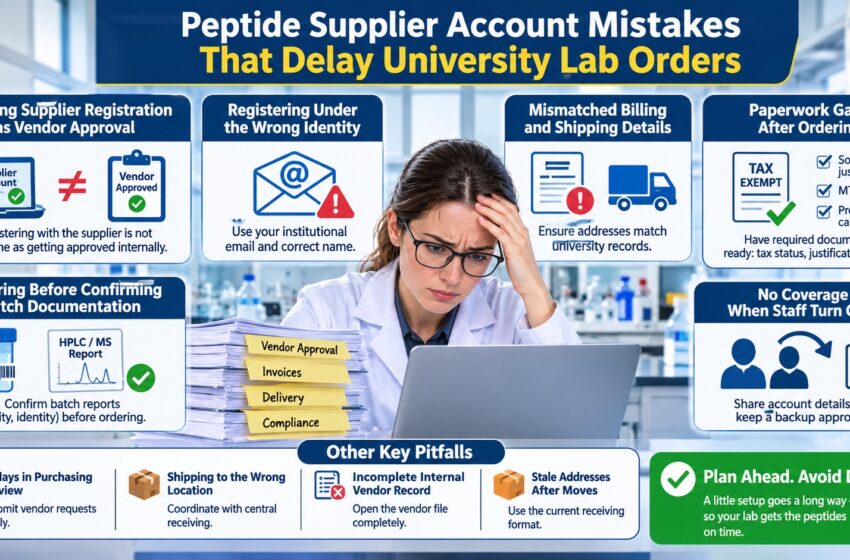
Treating supplier registration as vendor approval
Opening an account on a supplier’s website and getting that supplier approved inside the university’s purchasing system are two separate processes. Lab managers who treat them as one step often find the gap only after a purchase order stalls.
The supplier account gives the lab catalog access and an ordering portal. The internal vendor record is what allows a purchasing office to issue a purchase order at all.
A lab can hold a supplier login for months and still be unable to buy, because the vendor file was never opened or sits incomplete. When a purchase order can’t be issued, it also can’t be matched to an invoice later, and the delay compounds at both ends of the transaction.
Purchasing offices generally need time to review a new vendor, and that review doesn’t begin until someone submits the request. Staff who start the internal vendor process the same week they register with the supplier keep that review from holding up the first order.
Registering under the wrong identity
Suppliers serving research institutions commonly tie accounts to institutional email domains. An account opened with a personal address may never link to the university’s existing vendor record, and order confirmations or invoices can land in an inbox that purchasing staff never see.
The name on the account causes as many problems as the address. An account registered to a graduate student or a principal investigator who has since moved on creates problems when invoices arrive under a name accounts payable can’t match to an active file. Generic inboxes create a related problem when the person who monitored them leaves or the address is abandoned.
A researcher sourcing premium research peptides such as retatrutide for in vitro studies, for example, may first need to register an account with the supplier. Registering with the institutional email address, and checking the billing and delivery details before the first order, costs less than correcting them after an invoice is issued.
Mismatched billing and shipping details
Billing information on a supplier account needs to match the record held by accounts payable. A missing suite number or an outdated department name can hold an invoice until someone reconciles the difference by hand.
Shipping details fail differently. Many universities route deliveries through central receiving docks, and a package sent to a lab’s street address or a building’s front desk may be refused or left untracked.
A missed delivery can also slow internal receipt, since a package that bounces back to central receiving may sit before it is rerouted to the lab. Coordinating delivery instructions with the supplier and the receiving dock ahead of time reduces that risk.
Addresses on file go stale when departments move buildings. Lab managers who copy the exact receiving format from a recent successful delivery, dock number included, avoid most of these failures.
Paperwork gaps that surface after ordering
Many universities ask vendors to keep a tax-exempt certificate on file, and an invoice that arrives with sales tax charged can bounce back for correction before payment is released.
Some institutions require a sole-source justification when a lab buys from one specific supplier without collecting competing quotes. Some purchases also fall under a Material Transfer Agreement, which adds a contract review before the material can change hands.
Smaller orders often run through procurement cards with dollar limits set by the department. An order that exceeds the limit may need rerouting through a full purchase order, which restarts the approval clock. Before routing any invoice for payment, reconcile items, quantities, charges, and reference numbers against the original order.
Ordering before confirming batch documentation
Research-grade peptides typically ship with batch-specific analytical data. High-Performance Liquid Chromatography results report purity, and Mass Spectrometry confirms identity and molecular weight.
Internal quality audits at some institutions ask for these reports before experimental work proceeds. Labs that confirm portal access to batch documentation before ordering avoid a specific stall: the compound arrives, but the audit paperwork is missing.
Retrieving reports at the time of order, while the batch number is current, is simpler than requesting them months later. Batch numbers change between orders, and a report pulled for last year’s shipment won’t satisfy an audit of this one.
No coverage when staff turn over
University labs run on temporary personnel. The graduate student or lab manager who registered the account and knew the approval chain eventually leaves, and orders stall when nobody inherits that knowledge.
Labs that treat account details as shared infrastructure handle turnover better. Credentials kept in a shared department system and a second person authorized to approve orders keep purchasing moving through personnel changes. A brief handover note that lists active vendors and pending orders gives the next manager a starting point.
Most of these failures are preventable with an hour of setup done in the right order. Labs that receive compounds on schedule tend to treat account administration as part of the experimental timeline, the same way they treat the work at the bench.
This article is part of
Find Cult