
How to Build a Home Gym That Actually Gets Used
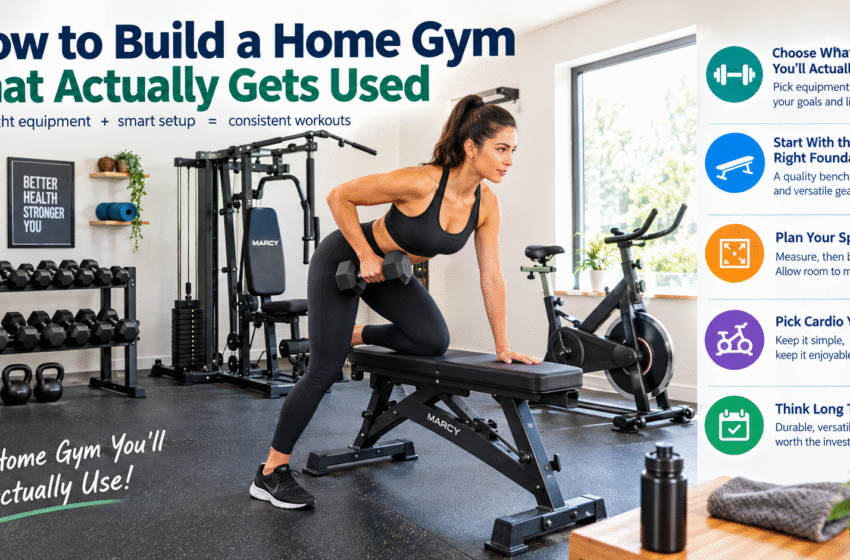
The gap between buying home gym equipment and actually using it consistently is where most home fitness investments go wrong. Equipment gets assembled, used enthusiastically for a few weeks, and then gradually becomes an expensive clothes rack. Understanding why that pattern happens and what actually prevents it changes how you approach building a home gym from the beginning.
The answer has less to do with motivation than most people assume and more to do with how the gym is set up and what equipment is chosen in the first place.
Table of Contents
Start With What You Will Actually Do
The most common home gym mistake is buying equipment for the workout you think you should be doing rather than the workout you will actually do. A treadmill that collects dust because you hate running is a worse investment than a piece of equipment you will use three times a week because you genuinely enjoy it. Resistance training equipment that sits unused because the setup feels complicated every time you approach it produces worse outcomes than simpler equipment you will pick up without thinking twice.
The equipment that gets used consistently is equipment that matches how you actually like to move, that does not require an elaborate setup process before each session, and that fits into the space you have in a way that does not make the space feel unusable for anything else.
The Equipment That Forms the Foundation of Most Home Gyms
Most effective home gym setups are built around a small number of foundational pieces rather than a large collection of specialized equipment that covers every possible exercise. The foundational pieces are those that allow the widest range of movements with the fewest separate purchases.
A weight bench is the single most versatile piece of resistance training equipment available for a home gym. A quality adjustable bench allows incline, flat, and decline pressing movements, seated exercises for shoulders and arms, and serves as a platform for dumbbell work across every major muscle group. The difference between a cheap bench that wobbles under load and a well-built one that stays stable and durable through years of daily use is significant enough that bench quality is worth prioritizing over bench cost.
Marcy’s home gym equipment line includes weight benches at multiple price points including the SB-350 Deluxe Utility Bench and the MD-857 Olympic Weight Bench, both of which represent the kind of stable, durable construction that produces a bench you will use for years rather than replace after months. The Olympic bench’s preacher curl attachment and leg developer extend its versatility beyond flat and incline pressing into curl and leg work, which means more complete training from a single piece of equipment rather than requiring separate purchases for each movement.
Home Gym Systems vs Individual Pieces
The decision between buying a comprehensive home gym system and assembling a collection of individual pieces involves tradeoffs that depend on space, budget, and how you prefer to train.
A home gym machine with a weight stack, like the Marcy Club 200lb Home Gym, consolidates a cable system, pulley movements, and resistance training into a single footprint. The advantages are real: no need to load and unload plates between sets, a fixed range of exercises that require no additional equipment, and a setup that stays in place and ready to use without configuration each session. The disadvantages are also real: the fixed cable system limits the exercise variety that free weights provide, and the initial cost is higher than buying a bench and a set of weights separately.
Free weights, meaning dumbbells and barbells with a quality bench, offer more exercise variety and more natural movement patterns than cable machines but require more equipment management and more space for storage. A combination of both, where a cable system handles pulling movements and free weights handle pressing and isolation work, produces the most complete training environment but requires more space and more investment.
Cardio Equipment: Choosing What You Will Actually Use
Home cardio equipment has a particularly poor track record for consistent use because most people buy based on the intensity of the workout rather than the enjoyability of the experience. A stationary bike that feels like work every time you approach it will not get used regardless of how effective the workout is. A bike that you genuinely do not mind sitting on for thirty minutes becomes a consistent part of the routine.
The Marcy Revolution Cycle represents the kind of functional, no-fuss cardio equipment that gets used because it does what it needs to do without complications. The simplicity that some buyers see as a limitation compared to feature-heavy connected fitness bikes is also what makes it consistently usable without the technical friction that elaborate fitness tech introduces.
Space Planning Before Purchase
The piece of advice most consistently ignored in home gym planning is measuring the space before buying anything. Equipment that fits in the showroom dimensions listed in a spec sheet does not always fit comfortably in the actual room when clearance for movement around the equipment is accounted for.
A weight bench needs clearance on both sides for dumbbell work and behind it for barbell racking. A cable machine needs clearance in front for cable movements at full extension. A bike needs clearance around it for mounting and dismounting safely. The functional space required for each piece of equipment is meaningfully larger than the equipment’s own footprint, and building a home gym without accounting for this produces a space that feels cramped and discourages use.
The Investment That Actually Pays Off
Home gym equipment is a long-term investment that pays off through consistent use over years, not months. The equipment that pays off is equipment that is durable enough to hold up through years of regular training, versatile enough to support your training as your fitness improves, and well-matched to how you actually prefer to train rather than how you imagine you will train once you have the equipment.
Marcy has been producing home gym equipment since 1982, and the durability and straightforward design that characterizes their line reflects four decades of understanding what home gym users actually need from their equipment over the long term.