
How to Overcome the Cycle of Shame and Self-Sabotage in Early Recovery
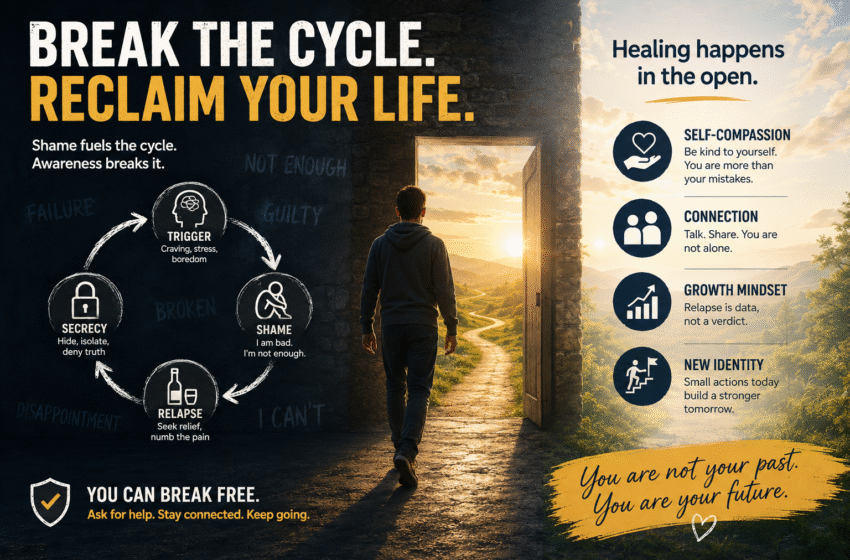
Shame keeps you stuck, makes you sick, and kills. It feeds a distorted, negative self-image and keeps you from knowing your real self or others. It damages your soul. It shames your very essence. Shame from what you did. Shame from what was done to you. Shame from what you failed to do. Shame for who you are. Shame causes you to hide; to deny your truth. Shame keeps you in torment. Shame is masked as anger, indifference, shyness, and carrying on as if it doesn’t hurt. Shame is an insidious disease.
Table of Contents
The loop, named out loud
Typically, you are a few weeks or months abstinent when a seemingly random craving hits, or you realize you are simply bored out of your mind, or a memory you haven’t dealt with pops up because you never even knew that’s what people did, become mindful of feelings. Something nudges you a little uncomfortably, and that thing is met with an avalanche of shame and secrecy. Because it’s not just an old memory; it is your history of using. It’s not simply a passing craving; it is every mistake, every needle, every moment strung out and lost. It’s not boredom; it’s something broken in you that no amount of abstinence will ever fix.
Shame is not guilt, and the difference matters clinically
Researcher Brené Brown explained a difference that has turned out to be fundamental in addiction psychology: guilt says “I did something bad.” Shame says “I am something bad.” Guilt is a problem but it points outside of yourself, at behavior, which means it can actually be useful – it tells you what to change. Shame points inside. There’s nothing to fix because the problem is supposedly you.
This is not a semantic difference. Early recovery work is, often, to turn shame into guilt without losing the lesson underneath it. “I lied to my partner about drinking” is a fact, and facts can be faced and acted upon – make a repair, change a pattern. “I’m a liar, I’ve always been a liar, I’ll always be one” is a verdict with no next step. One motivates change. The other is just hurt, and hurt without direction is what pushes people back toward the thing that used to numb it.
Why shame spikes right before a slip
Shame and cravings are linked from a neurobiological perspective, because the feeling of shame activates the same brain circuit that is stimulated by a physical threat. Your amygdala (the brain’s burglar alarm) lights up when you’re in shame, your cortisol levels rise, and your prefrontal cortex – the part of your brain that weighs consequences and thinks into the future beyond the next ten minutes – goes quiet. This isn’t a character flaw. This is what brains do when a threat to the self is perceived, and shame is registered as a threat to the self.
What this means for you on a practical level is that just at the moment you need your clearest thinking and your best planning, all your brain can think about is relief this second. You can’t solve complicated neurobiology problems when your brain is just trying to pull out from under a terrible feeling. The survival part of your brain doesn’t care that this relief is bringing worse trouble to your door in a few minutes. It just knows that right now, dying alone sounds worse than any other possible option.
When it’s bigger than willpower
For a lot of people, most of the time, everything above works. But not for everyone, and it’s true that we need to get better at saying that. We need to do that instead of throwing our hands up and leaving the hard cases at the margins. The shame spirals that wind all the way down to trauma, to adverse childhood experiences, to co-occurring mental health conditions are tenacious in ways that random self-help strategies can’t reach. Especially toxic shame – that invasive, implicit self-loathing that can stand in isolation from any specific sip-then-relapse moment.
If you’re seven levels deep in the wound, and you’ve written the gratitudes, and played the tape forward, and the shame keeps coming, try something else. That’s not failing at self-improvement, that’s what hitting the limits of self-directed work looks like. You need more hands on treatment. That’s what we have therapists for. And medical interventions like antidepressants. Inpatient treatment. Maybe your level of care should have been matched to your level of need rather than based on an honest assessment of your own self-worth. Programs like https://legacyhealingnj.com/ exist specifically for the cases where willpower and journaling exercises aren’t enough on their own, and reaching for that kind of support isn’t a failure of the work you’ve already done – it’s a continuation of it.
Self-compassion as the actual antidote
Psychologist Kristin Neff has dedicated years studying self-compassion as a measurable skill, rather than an abstract concept. Her approach comprises self-kindness over self-judgment, understanding that difficulties are part of every human being instead of evidence that something is wrong with you, and being aware through mindfulness of the suffering instead of immersing yourself in it. Her studies have consistently shown that those who practice self-compassion have lower levels of feeling shame and are more resilient in the face of adversity.
For those in recovery, the best way to explain this is: how would you talk to yourself after relapsing and how would you talk to someone whom you’ve already lost the trial to? The first would elicit questions like what happened, what went wrong, and what were you lacking. The second would just be a long list of offenses. Most individuals see their relationship with themselves as a trial. The idea of self-compassion is not to get off the hook but to change the nature of the questions asked.
An exercise for the inner critic
The negative self-talk in your head is the inner critic and essentially a bully. Put it on trial and challenge the self-criticism by transforming it into a written exchange. What follows is a guide to help you confront and talk back to the inner critic that lurks within.
- Name a specific form/voice of self-criticism that you struggle with and describe it in the second person (i.e., “you’re never going to amount to anything”). Be as detailed as possible.
2. Write a compassionate and constructive response to this voice. Be specific. Offer a real counter-argument rather than just empty affirmations.
Shame dies in the open
Shame relies on everything that is kept hidden. It wants you to think that if specific people knew particular things about you, it would be all over. However, once you share the unspeakable thing with someone safe, it typically loses its control over you. The fact may remain the same, but you realize that you are still accepted even after confessing it.
This is why 12-step structures are so effective. Step work, having a sponsor, and sharing in meetings are not just random things these groups do. It’s an active practice of regularly vocalizing the things that shame wants to stay hidden. If you aren’t in a 12-step program, the rule still applies, but this dynamic can be fostered through a therapist, a trusted friend in recovery, or a structured support group. This week, try to find one person or one room and say the thing you’ve been avoiding saying.
Relapse is data, not a verdict
Research on relapse prevention, which goes back to the fundamental work of Alan Marlatt, has considered relapse as a process characterized by phases; it is not an isolated overwhelming negative event that deletes everything that came before. A lapse is valuable information about a certain trigger, a hole in your strategy, a skill you have yet to develop. It is not an indication that your recovery has failed or that you are unable to recover.
Understanding the statistics can be beneficial here. The relapse percentage for substance dependency is around 40 to 60 percent, which is similar to the relapse percentages for other chronic illnesses such as hypertension and asthma. Nobody says to a person with asthma that they are a disappointment as a human because they experienced a flare-up. Addiction should be treated like any other chronic illness with a relapse rate, and not as a moral issue where you either succeed or fail for the rest of your life.
Disrupting the relapse-shame-relapse cycle means considering a lapse like you would other clinical data: What was going on before it happened, what was lacking, what modifications need to be made to your strategy? This is a completely different question to ask yourself compared to, “What’s wrong with me?”
Building an identity to grow into
The reason early recovery is so early is that it’s here, it’s now, and it’s fragile, in ways that it won’t be later. It’s easier to slide from it, to convince yourself that you didn’t mean it anyway, to turn from yourself before the dagger’s all the way in, here. It’s all excuses, and bad days, and loneliness, and exhaustion. It’s all grief, even the good parts. And grief is what you make yourself drink down instead of alcohol. It is mourning, and toxic bitterness.
Making it here is easier if you keep the thing, the good thing that you wanted, that you started towards when you set off on this long road. If you put it up in front of you like a lantern. And the old identity doesn’t care about lanterns. It holds out drinks to you, and lights cigarettes. Grins, and says, why the mess are we out here in the dark, man? You look over your shoulder, stumble, don’t quite know what sucked you forwards. Countering that means deliberately building a new identity, on paper, before it feels fully true. Write a short identity statement: who you are now, not who you used to be. What you’re building toward. One small, concrete action you can take today that’s proof – not a promise – of that identity. Go to the meeting. Make the call. Tell the truth about the hard day instead of hiding it. Small actions repeated are what identity shift actually looks like from the inside.
The loop can be interrupted
None of this erases shame. It resurfaces, especially early on, especially when stressed. But the difference is you start to see it coming. You see the shame-hole form most of the way, you’ve got a buddy or a sponsor who has listened to your worst hit and hasn’t run for the hills, and you have an idea of what a slip constitutes rather than awaiting a ruling. That’s not shamelessness. That’s just a lot less room for shame to maneuver.