
Winter Skin Care – Face Packs for instant Glow in Winter
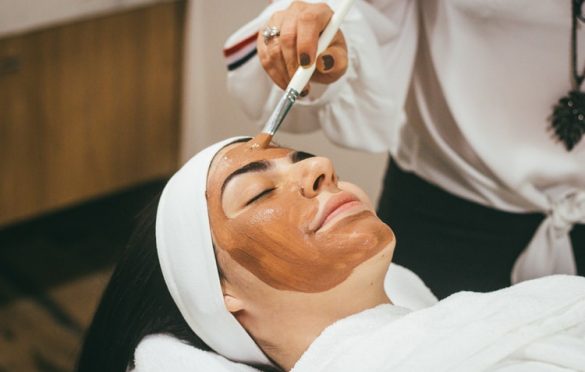
Winter is beautiful — but it is not kind to your skin. The combination of cold outdoor air, low humidity, indoor heating, and reduced water intake creates the perfect storm for dull, dry, tight, and flaky skin. The natural glow that was easy to maintain in warmer months suddenly requires a little more effort.
The good news is that glowing winter skin is entirely achievable — and some of the most effective solutions are sitting in your kitchen right now. Natural face packs made from ingredients like honey, turmeric, banana, and oats have been used for centuries to nourish, hydrate, and brighten skin. When applied consistently, they deliver real, visible results.
This guide covers why winter affects your skin the way it does, the seven best face packs for an instant winter glow (with full ingredients and instructions), how to build a simple winter skincare routine around them, and practical tips to keep your skin healthy all season.
Table of Contents
Why Winter Is So Hard on Your Skin
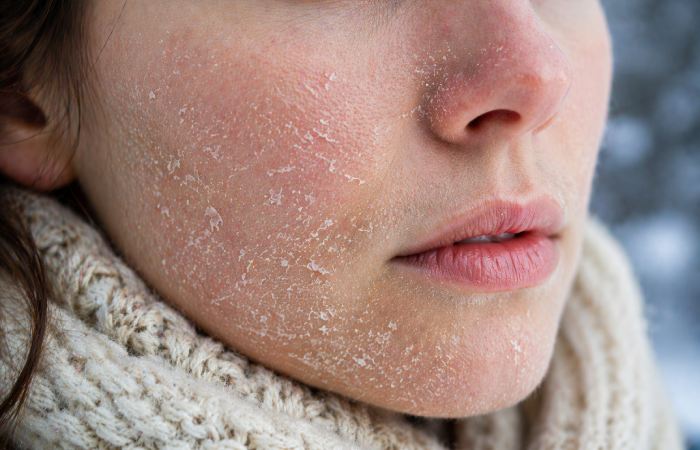
Understanding what winter does to your skin helps you choose the right treatments and ingredients. Dullness and dryness in winter are not random — they have specific causes that face packs can directly address.
- Cold air holds less moisture: Cold air has a lower capacity to hold water vapor than warm air. This means the air itself is drier in winter — pulling moisture from exposed skin continuously, even on cloudy days with no wind.
- Indoor heating strips humidity further: Central heating, radiators, and fireplaces reduce indoor humidity dramatically. The air inside a heated room in winter can be drier than a desert. This accelerates transepidermal water loss (TEWL) — the passive loss of moisture through the skin barrier.
- Reduced blood circulation to the skin: In cold weather, the body prioritizes keeping core organs warm by constricting surface blood vessels. Reduced blood flow to the face means fewer nutrients and less oxygen reaching skin cells — directly contributing to the dull, grey tone that many people notice in winter.
- Slower cell turnover: Cold temperatures slow down biological processes, including the natural exfoliation cycle of skin. Dead cells accumulate on the surface more slowly than they shed, creating a rough, uneven texture and muting the skin’s natural radiance.
- Compromised skin barrier: The skin barrier — a protective layer of lipids and proteins — is more easily disrupted in cold, dry conditions. A weakened barrier loses moisture faster, becomes more reactive, and allows irritants to penetrate more easily.
What Face Packs Actually Do for Winter Skin
A well-chosen face pack delivers a concentrated dose of active ingredients to the skin in a format that stays in contact long enough to be absorbed and act. For winter skin specifically, the best face packs serve multiple functions simultaneously:
- Hydration and moisture retention: Ingredients like honey, aloe vera, and glycerin are humectants — they draw water into the skin and hold it there, immediately plumping dull, dehydrated cells.
- Gentle exfoliation: Ingredients like oats, papaya enzymes, and yogurt lactic acid remove the layer of dead cells that accumulate in winter, allowing light to reflect more evenly off the skin surface — which is the primary driver of visible glow.
- Brightening: Turmeric, vitamin C-rich ingredients (lemon juice used carefully, tomato, papaya), and niacinamide-containing foods address melanin overproduction and uneven pigmentation that can worsen in winter.
- Barrier support: Oils and fats — coconut oil, almond oil, egg yolk — supply essential fatty acids that reinforce the skin barrier, reducing moisture loss after the pack is removed.
- Circulation stimulation: Some ingredients, including ginger and cinnamon (used in very small amounts on non-sensitive skin), mildly stimulate surface circulation — improving that blood-flow-driven natural flush.
1. Honey and Banana Face Pack — Deep Hydration and Instant Radiance

Best for: Dry and normal skin | Time: 15–20 minutes | Frequency: 2–3 times per week
Why This Works
Honey is one of the most well-researched natural skincare ingredients. It is a natural humectant — drawing moisture into the skin — and contains hydrogen peroxide-generating enzymes that give it mild antimicrobial properties. Raw honey also contains antioxidants and trace minerals that support skin health. Banana is rich in vitamins B6, C, and potassium, and contains natural oils that nourish and soften dry skin. Together, they create one of the most effective natural hydration treatments available.
Ingredients
- 1 ripe banana (the riper the better — black-spotted bananas have more active nutrients)
- 1 tablespoon raw honey (raw honey retains more active enzymes than processed)
- Optional: a few drops of almond oil for very dry skin
Method
- Mash the banana thoroughly until smooth — no lumps
- Mix in the honey and almond oil if using
- Cleanse your face and pat dry
- Apply an even layer to your face and neck, avoiding the eye area
- Leave for 15–20 minutes
- Rinse with lukewarm water (not hot — hot water strips moisture)
- Follow with your regular moisturizer while skin is still slightly damp
2. Turmeric and Milk Face Pack — Brightening and Even Skin Tone
Best for: All skin types (use minimal turmeric for fair skin) | Time: 15 minutes | Frequency: Once or twice per week
Why This Works
Turmeric contains curcumin — a compound with well-documented anti-inflammatory and antioxidant properties. Research published in dermatology journals has found that topical curcumin can reduce melanin production, helping to brighten uneven skin tone and fade hyperpigmentation over time. Milk contains lactic acid — a gentle alpha hydroxy acid (AHA) that exfoliates the surface of the skin, removing dead cells and improving luminosity. Combined, they address two of the main causes of winter dullness simultaneously.
Ingredients
- 1/4 teaspoon turmeric powder (use sparingly — it stains)
- 2 tablespoons whole milk or yogurt
- 1 teaspoon honey
- Optional: a pinch of sandalwood powder for additional brightening
Method
- Mix all ingredients into a smooth paste
- Apply to clean face, avoiding the eye area
- Leave for 15 minutes — do not let it dry completely
- Rinse thoroughly with lukewarm water
- Note: turmeric may leave a faint yellow tint on the skin. This fades within an hour. Apply in the evening if concerned.
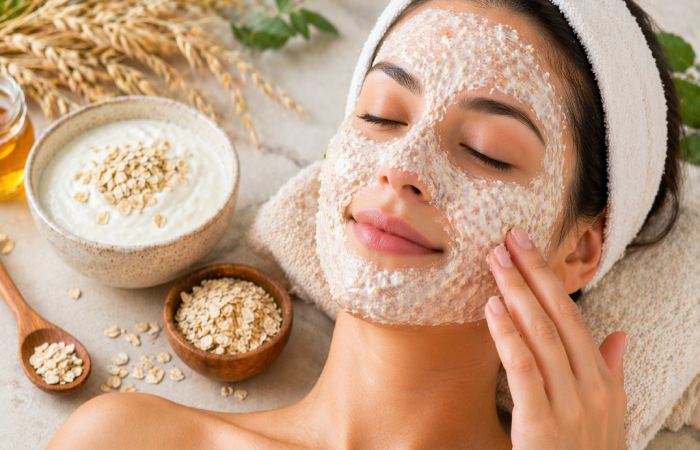
3. Oat and Yogurt Face Pack — Gentle Exfoliation and Soothing
Best for: Sensitive, dry, and irritated skin | Time: 20 minutes | Frequency: 2–3 times per week
Why This Works
Colloidal oatmeal is one of the few natural ingredients with FDA-recognized status as a skin protectant, supported by peer-reviewed research on PubMed documenting its beta-glucan barrier and anti-inflammatory properties. Oats contain beta-glucan — a polysaccharide that forms a protective film on the skin surface, retaining moisture and reducing inflammation. Oat starches and proteins also gently cleanse without stripping. Yogurt provides lactic acid for gentle chemical exfoliation plus probiotics that may support the skin microbiome. This is the most universally gentle pack on this list — suitable for most sensitive skin types.
Ingredients
- 3 tablespoons plain rolled oats (blend to a fine powder for sensitive skin, leave coarser for gentle physical exfoliation)
- 2 tablespoons plain full-fat yogurt
- 1 teaspoon honey
- Optional: a few drops of rose water for added soothing
Method
- Mix oats, yogurt, and honey until combined
- Apply to clean face in gentle circular motions if using as a scrub, or simply pat on as a mask
- Leave for 15–20 minutes
- Remove with damp cloth or lukewarm water using gentle circular motions
- Apply moisturizer immediately
4. Avocado and Olive Oil Face Pack — Intense Nourishment for Very Dry Skin
Best for: Very dry and mature skin | Time: 20 minutes | Frequency: Once or twice per week
Why This Works
Avocado is extraordinarily rich in monounsaturated fatty acids — particularly oleic acid — that penetrate deeply into the skin and replenish the lipid barrier. It also provides vitamins E, K, and C, along with beta-sitosterol which has anti-inflammatory properties. Olive oil is similarly rich in oleic acid and polyphenol antioxidants. Research has found that topical application of these oils supports barrier function and reduces TEWL. This pack is essentially a rich, natural emollient treatment that winter-depleted skin absorbs eagerly.
Ingredients
- 1/2 ripe avocado
- 1 teaspoon extra-virgin olive oil
- 1 teaspoon honey
- Optional: a few drops of vitamin E oil (from a capsule)
Method
- Mash the avocado until completely smooth
- Mix in olive oil, honey, and vitamin E oil if using
- Apply generously to clean face and neck
- Leave for 20 minutes — the oils need time to penetrate
- Remove with a warm, damp cloth (this pack is rich — water alone may not rinse it fully)
- Follow with a light moisturizer — your skin may not need much after this treatment
5. Papaya and Honey Face Pack — Natural Enzyme Brightening
Best for: Normal, combination, and dull skin | Time: 15 minutes | Frequency: Once or twice per week
Why This Works
Papaya contains papain — a proteolytic enzyme that breaks down the keratin proteins holding dead skin cells to the surface. This is the same mechanism used in professional enzyme peels. Papain dissolves the dead cell layer gently and without physical abrasion, making it one of the most effective natural exfoliants available. Papaya also contains vitamins A and C and lycopene — antioxidants that protect against free radical damage and support collagen production. Honey adds its humectant and antibacterial properties to complete a pack that exfoliates, brightens, and hydrates simultaneously.
Ingredients
- 3–4 tablespoons ripe papaya (mashed)
- 1 tablespoon honey
- Optional: a few drops of lemon juice (skip if skin is sensitive)
Method
- Mash papaya until smooth
- Mix in honey and lemon juice if using
- Apply to clean face, avoiding the eye area
- Leave for 15 minutes
- Rinse with cool water — cool water helps close pores after enzyme exfoliation
- Apply SPF the next morning if you used lemon juice — citrus increases photosensitivity
6. Egg Yolk and Olive Oil Face Pack — Rich Lifting and Barrier Repair
Best for: Dry and mature skin | Time: 15 minutes | Frequency: Once per week
Why This Works
Egg yolk is rich in lecithin — a natural emulsifier and humectant that helps the skin retain moisture — as well as vitamins A, D, and E and essential fatty acids. These nutrients directly support skin barrier integrity and hydration. The fats in egg yolk create a temporary plumping effect that reduces the appearance of fine lines. Olive oil adds oleic acid and antioxidants. This is a particularly effective pack for skin that feels tight and uncomfortable in winter.
Ingredients
- 1 egg yolk (separate carefully from the white)
- 1 teaspoon olive oil or almond oil
- Optional: 1 teaspoon honey
Method
- Whisk egg yolk lightly
- Mix in oil and honey
- Apply to clean face in upward strokes
- Leave for 15 minutes
- Rinse thoroughly with lukewarm water to remove all egg residue
- Apply moisturizer
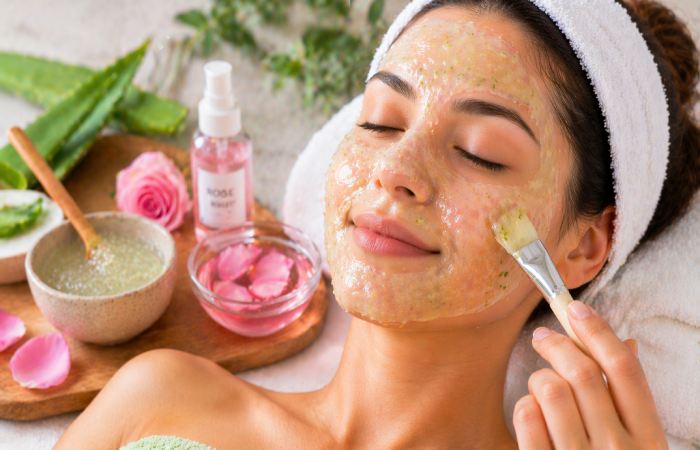
7. Aloe Vera and Rose Water Face Pack — Lightweight Hydration for Oily and Combination Skin
Best for: Oily, combination, and acne-prone skin | Time: 20 minutes | Frequency: 3 times per week
Why This Works
Aloe vera gel is one of the most researched natural skincare ingredients. It contains over 75 active compounds including vitamins C and E, enzymes, polysaccharides, and salicylic acid. Its gel structure provides lightweight hydration without clogging pores — making it the rare ingredient that hydrates oily skin without triggering breakouts. Rose water is a natural astringent and anti-inflammatory. It balances the skin’s pH, reduces redness, and has a mild toning effect. Together they create a hydrating, balancing pack that is perfect for oily skin that still dehydrates in winter.
Ingredients
- 2 tablespoons pure aloe vera gel (from the plant or a high-purity commercial gel with no added alcohol)
- 1 tablespoon rose water
- Optional: 2–3 drops tea tree oil for acne-prone skin
Method
- Mix aloe vera gel and rose water until combined
- Add tea tree oil if using — mix well
- Apply to clean face in an even layer
- Leave for 20 minutes — this pack can also be refrigerated before use for a cooling, de-puffing effect
- Rinse with cool water
- A light moisturizer or serum can be applied after, though oily skin may not need much
Which Face Pack Is Right for Your Skin Type?
Here is a quick guide to matching these packs to your skin’s winter needs:
- Dry skin: Honey & Banana, Avocado & Olive Oil, Egg Yolk & Olive Oil
- Very dry or mature skin: Avocado & Olive Oil, Egg Yolk & Olive Oil
- Oily or combination skin: Aloe Vera & Rose Water, Oat & Yogurt
- Dull skin needing brightening: Turmeric & Milk, Papaya & Honey
- Sensitive or irritated skin: Oat & Yogurt, Aloe Vera & Rose Water
- All-round winter glow (normal skin): Honey & Banana, Papaya & Honey, Turmeric & Milk
Beyond Face Packs: A Simple Winter Skincare Routine That Works
Face packs deliver intensive treatment, but they work best as part of a consistent routine. Here are the fundamentals of a winter skincare routine that supports and extends the results of your face pack treatments:
- Switch to a cream or oil cleanser: Foaming cleansers that feel squeaky-clean strip the skin’s natural oils — exactly what you do not want in winter. A cream or oil cleanser removes impurities without disrupting the barrier.
- Layer hydration — hydrating serum first, then moisturizer: Apply a hyaluronic acid serum to damp skin before your moisturizer. Hyaluronic acid draws in atmospheric moisture; the moisturizer seals it in. This layering approach is significantly more effective than moisturizer alone.
- Never skip SPF, even in winter: UV radiation does not disappear in winter — it remains present even on cloudy days and reflects off snow. Daily SPF 30+ is non-negotiable for skin health and preventing the hyperpigmentation that brightening treatments work to reverse.
- Use a humidifier indoors: Adding moisture back to the air in your living and sleeping spaces directly reduces TEWL and prevents the overnight moisture loss that makes skin feel parched in the morning.
- Drink enough water: Dehydration is a less dramatic but real contributor to dull winter skin. Warming herbal teas and warm water with lemon count toward your daily fluid intake.
- Use a gentle, weekly physical exfoliant: In addition to face packs, a light physical or chemical exfoliant once per week prevents dead cell buildup and keeps skin receptive to the nourishing ingredients in your packs and serums.
Clinical Sources Referenced:
- American Academy of Dermatology (AAD) — Winter Skin Care Tips: aad.org
- National Institutes of Health (NIH) / PubMed — Research on Colloidal Oatmeal and Honey in Skin Care: pubmed.ncbi.nlm.nih.gov
- FDA — Colloidal Oatmeal as a Skin Protectant: fda.gov
Frequently Asked Questions (FAQ)
Common questions about winter skincare and natural face packs.
How often should I use a face pack in winter?
For most skin types, 2–3 times per week is an effective frequency for face packs in winter. Hydrating packs (honey, aloe vera, banana) can be used more frequently — even daily for very dry skin — as they do not stress the skin. Exfoliating packs (oat with scrubbing action, papaya enzyme) should be limited to once or twice per week to avoid over-exfoliating. Richer oil-based packs (avocado, egg yolk) are best used once or twice per week.
Can I use these face packs if I have oily skin?
Yes — oily skin still dehydrates in winter. The key is choosing lightweight, non-comedogenic options. The aloe vera and rose water pack and the oat and yogurt pack are both excellent choices for oily skin. Avoid the rich oil-heavy packs (avocado, egg yolk, olive oil) if your skin is prone to breakouts, as these can clog pores on oily skin types.
Why does my skin look dull in winter specifically?
Winter dullness has three main causes: dead cell accumulation (cold temperatures slow the natural exfoliation cycle), reduced blood circulation to the skin’s surface (the body constricts surface vessels to conserve core heat), and dehydration (dry winter air draws moisture from skin continuously). Face packs address all three simultaneously — exfoliating dead cells, stimulating circulation through massage and active ingredients, and delivering concentrated hydration.
Is turmeric safe to use on all skin tones?
Turmeric is safe for all skin tones and actually has a brightening effect that benefits deeper skin tones by addressing hyperpigmentation. However, use it in small quantities (1/4 teaspoon or less) and rinse thoroughly. On very fair skin, it may leave a temporary yellow tint that fades within an hour. Applying in the evening avoids any daytime visibility of this tint. If you experience any redness or irritation, discontinue use.
Can I store homemade face packs?
Most of the packs in this guide contain fresh ingredients — banana, egg, avocado, papaya — that spoil quickly. They are best made fresh and used immediately. The aloe vera and rose water pack can be stored in the refrigerator in a clean airtight container for 2–3 days. The oat and yogurt pack can be stored for 1–2 days. Never store packs containing raw egg or fresh fruit beyond the same day — discard any unused portion.
Final Thoughts: Glowing Winter Skin Starts in Your Kitchen
The best winter skincare does not have to come from a high-end counter or an elaborate multi-step system. Some of the most effective ingredients for nourishing, brightening, and protecting skin in winter — honey, oats, turmeric, aloe vera, avocado — are also the most accessible.
The key is consistency and choosing the right pack for your specific skin type and concern. Whether your winter skin needs deep hydration, gentle exfoliation, brightening, or barrier repair — or a combination of all four across the week — there is a face pack in this guide that addresses it.
Start with one pack that matches your skin type, use it consistently for two weeks, and pay attention to how your skin responds. Glow is not a single product — it is the result of nourishment, hydration, and care applied with intention.
Also Read: hydrafacial